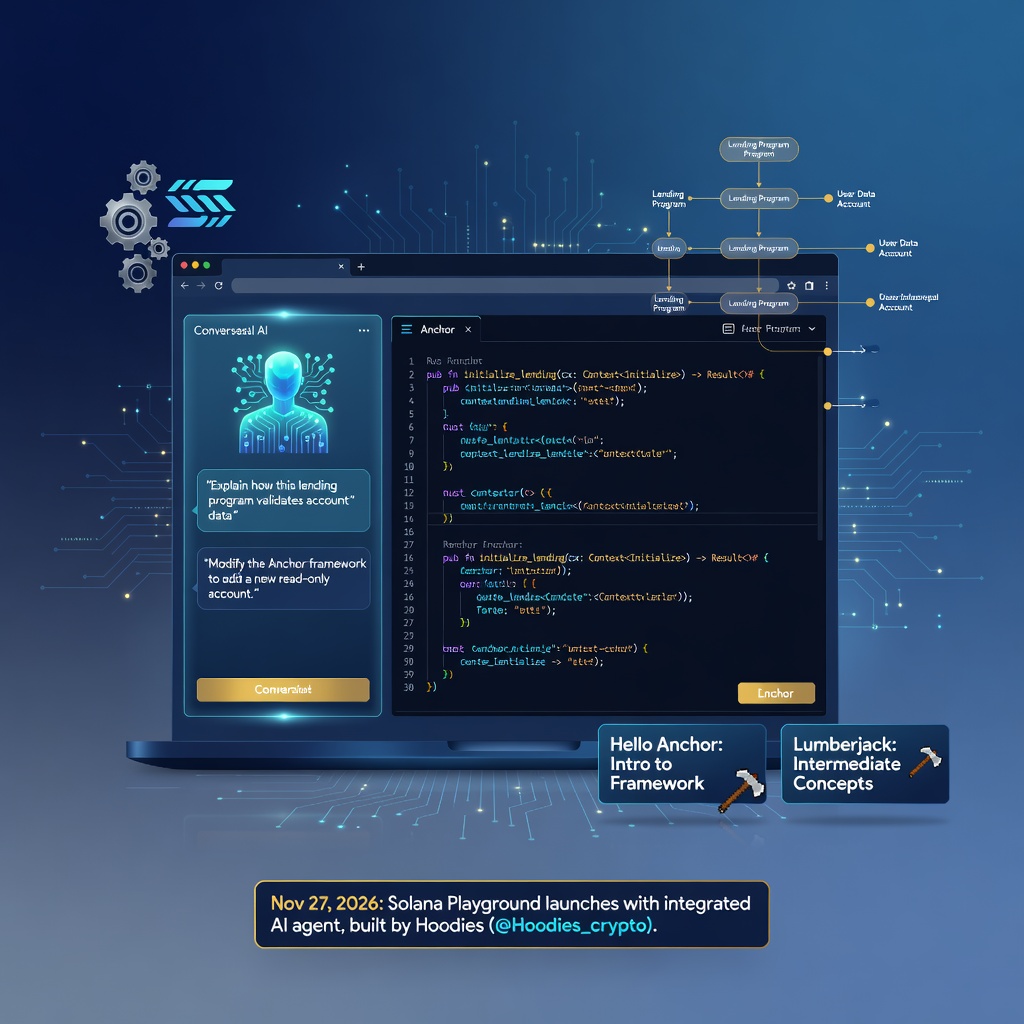
A developer exploring an unfamiliar Solana program can ask why it handles an account a certain way, then request an edit in the same browser workspace. On Nov. 27, 2026, Solana announced a version of Solana Playground that pairs its browser-based development environment with a conversational AI agent. Solana Developers credited Hoodies, who uses the handle @Hoodies_crypto on X, with building the platform.
Start with an example or a new program
The announcement demo showed 10 existing Solana programs to explore and three guided learning paths. Those paths include Hello Anchor, an introduction to the Anchor framework, and Lumberjack, an intermediate project. Developers can ask the agent to explain a section of code or modify it as they work.
For a new project, the choice is between Anchor and native Solana development. Solana calls its smart contracts programs: they execute instructions, while separate accounts hold application data. A lending program, for example, must define which accounts it can read or change. Anchor provides tools for describing those interactions and validating the information supplied with a transaction. Native development gives the programmer more direct control without the framework’s abstractions.
What the AI integration changes
Writing and deploying programs from a browser predates the AI assistant. The earlier open-source Solana Playground, also known as SolPg, let developers compile Rust programs, manage development wallets and deploy code without installing a local Solana toolchain.
Anchor’s documentation describes the testing workflow for that earlier environment: create a browser wallet, obtain test SOL from a faucet on Solana’s developer network, compile and deploy the program, then run tests against the deployed code. The test tokens do not require spending real funds. What the Nov. 27 announcement adds is the ability to discuss and edit code with an agent inside the workspace.
AI tools beyond the editor
Solana’s developer portal also offers instructions that builders can give their preferred AI coding tools to configure an environment and work with Solana libraries. Its application guides cover issuing tokenized assets with compliance controls, adding USDC to an online checkout and building automated payment services with the x402 protocol.
Separate from Playground, solana.ai brings together infrastructure for autonomous trading, wallet management and stablecoin payments. Its launch was reported on Nov. 23. At Breakpoint 2026, the Solana Foundation said more than 120 teams were developing AI products in the ecosystem.
Earlier in November, the Foundation introduced Confidential Compute, an open-source toolkit developed with Nito. It lets applications process sensitive information inside protected hardware and record hardware verification data on Solana. The Foundation has also outlined 11 startup ideas in areas including AI inference, stablecoin payments, tokenized collectibles and housing futures. Teams pursuing those ideas can apply through its Builder Program for grants, technical resources, marketing and hiring support, and infrastructure credits.