
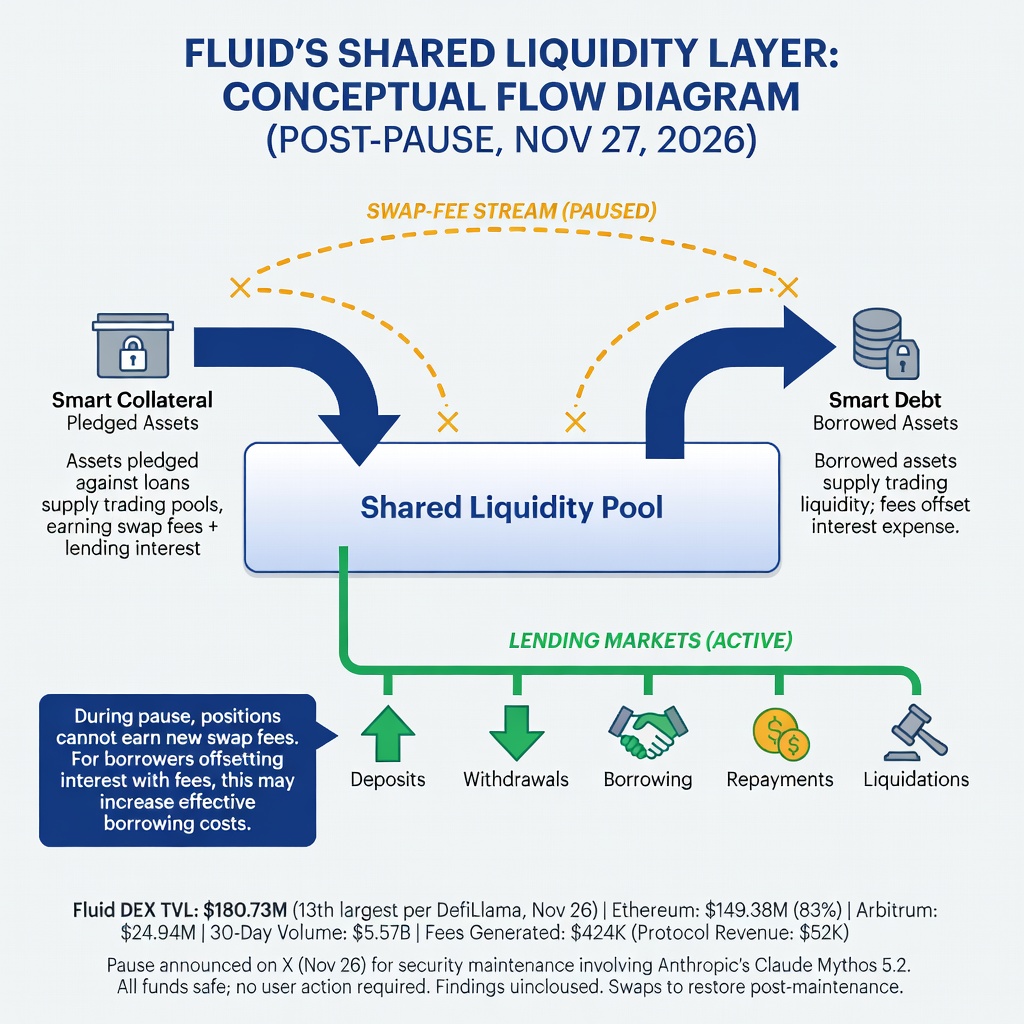
When the story was reported on November 27, 2026, at 10:42:07 UTC+8, token swaps on Fluid’s decentralized exchange (DEX) were paused, but users could still deposit and withdraw assets, take out loans and repay debt. Liquidations also continued as usual.
Fluid announced the pause on X on November 26, describing it as security maintenance following a review involving Anthropic’s Claude Mythos 5.2. “All funds remain safe, and no user action is required,” Fluid said. The team did not disclose the review’s findings or identify a specific smart-contract vulnerability. It said it would restore swaps once maintenance was complete.
What the pause means for borrowers
Fluid, developed by the team behind Instadapp, connects its lending markets and exchange through a shared pool of liquidity. According to Fluid’s documentation, its Smart Collateral feature lets assets pledged against a loan also supply a trading pool, earning swap fees alongside lending interest. Smart Debt works on the borrowing side: borrowed assets can supply trading liquidity, and the resulting fees can offset part of the borrower’s interest expense.
Neither type of position can earn new fees from the affected swaps during the pause. For borrowers who use those fees to offset interest, that could mean a higher effective borrowing cost even though borrowing and repayment remain available.
How much liquidity the exchange held
On November 26, DefiLlama recorded approximately $180.73 million in total value locked on Fluid’s exchange, ranking it 13th among the DEXs it tracked by that measure. Ethereum accounted for $149.38 million, nearly 83% of the total. Arbitrum held $24.94 million, with the rest spread across Base, Plasma and Polygon.
Over the preceding 30 days, the exchange processed $5.57 billion in trades and generated more than $424,000 in fees, of which roughly $52,000 was recorded as protocol revenue. Across all its products, Fluid had more than $826 million in total value locked. Fluid reported that deposits in its Sui lending markets surpassed $47 million within a week of launch. Those markets use Sui’s Hashi infrastructure to let users borrow USDC against hBTC without selling their underlying Bitcoin holdings.
What Mythos 5.2 contributed to the review remains undisclosed
Anthropic released Claude Mythos 5.2 on November 9. The company said the model outperformed its predecessors at identifying software vulnerabilities, reproducing flaws and developing fixes. In a security company’s assessment, about one in six confirmed vulnerabilities that Mythos 5.2 found had escaped detection by every other advanced AI model tested. That result concerned the assessment, not Fluid’s contracts. Anthropic restricts advanced cybersecurity capabilities to verified organizations; enterprise customers can use the model to examine software repositories through Claude Security.
Other crypto teams had explored related tools before Fluid’s announcement. In October, Ethereum client developer Nethermind and Bitcoin wallet provider ZEUS applied for access to Anthropic’s free scanner for open-source software. In August, Kraken parent Payward joined Project Glasswing and outlined plans to examine its infrastructure with Claude Mythos 5.
In June, Zcash underwent a Mythos-assisted audit after developers addressed a flaw in its Orchard shielded transaction pool that could theoretically have allowed counterfeit ZEC to be created. Zcash founder Zooko Wilcox said Anthropic conducted the subsequent review at Shielded Labs’ request and found no further serious vulnerabilities.