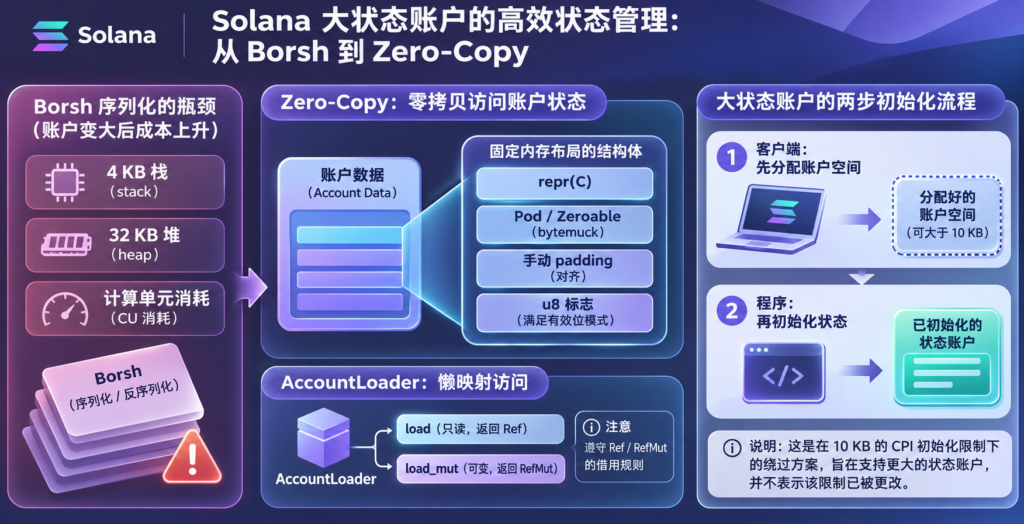
For builders working with large Solana accounts, the practical question is how to read and update state without repeatedly deserializing the entire account. In an article published November 16, 2026, at 00:43 (UTC+8), LearnBlockchain explains why Borsh serialization can become costly as accounts grow, citing a 4 KB stack, a 32 KB heap and compute-unit (CU) consumption as constraints.
The article describes a zero-copy approach that maps account data to a defined structure. It uses Rust’s repr(C) to fix the memory layout and bytemuck’s Pod and Zeroable traits for the required conversions. Manual padding and u8 flags address alignment and valid bit-pattern requirements. It also covers AccountLoader’s load and load_mut methods for lazy access, with attention to the borrowing rules of Ref and RefMut.
For larger state accounts, the article describes a two-step initialization workflow in which the client first allocates account space. This is presented as a way around the 10 KB cross-program invocation (CPI) initialization limit—not as a change to that limit.
Source: learnblockchain.cn (originally published 2026-11-16 00:43 UTC+8)