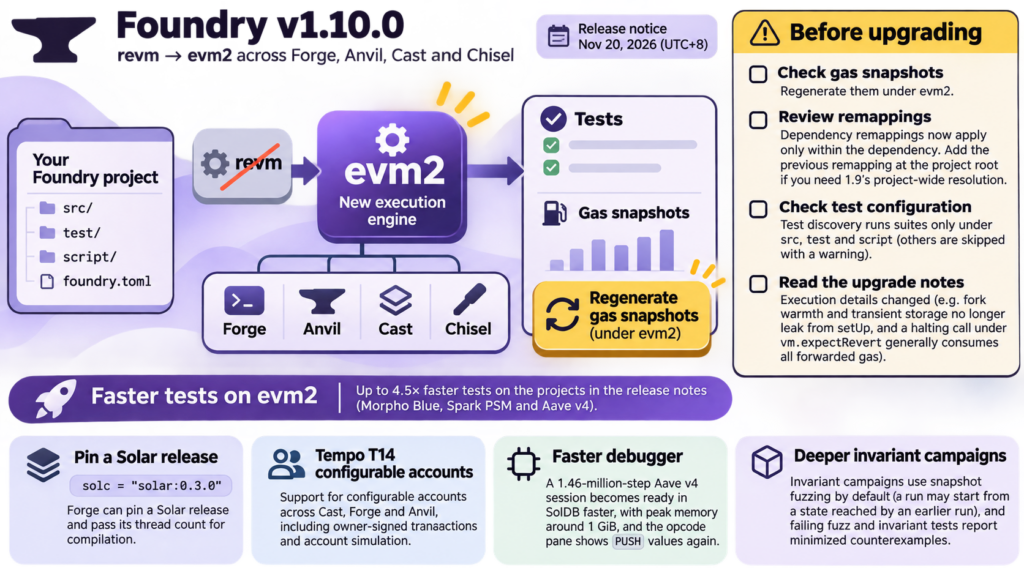
Before upgrading a Foundry project, check its gas snapshots, remappings and test configuration. In a release notice published on November 20, 2026 (UTC+8), the Foundry team said version 1.10.0 replaces revm with the evm2 execution engine across Forge, Anvil, Cast and Chisel. The change can affect test results and gas measurements, so the team advises reading its upgrade notes before switching.
Test results and upgrade checks
Foundry reports that forge test is 4.5× faster than version 1.9.0 on Morpho Blue, 3.5× faster on Spark PSM and 2.1× faster on Aave v4. Those are results for the projects named in the release notes, not a promise of the same speedup for every test suite.
The release notes call for regenerating gas snapshots under evm2. They also flag execution changes: fork warmth and transient storage no longer leak from setUp, and a halting call under vm.expectRevert generally consumes all forwarded gas, as it would on-chain. Tests that subsequently run out of gas may need to forward a fixed amount to that call.
Dependency remappings that conflict with another dependency or a root path now apply only within the dependency. That can change which code a dependency compiles against; adding the previous remapping at the project root restores version 1.9’s project-wide resolution. By default, test discovery runs suites only under src, test and script, with a warning for skipped project suites. Invariant campaigns also use snapshot fuzzing by default, so a run may begin from a state reached by an earlier run rather than from setUp.
Other developer-tool changes
Forge can pin a Solar release with solc = "solar:0.3.0", downloading it if needed, and can pass its thread count to Solar for compilation. Failing fuzz and invariant tests now report minimized counterexamples. The release also adds configurable-account support for Tempo T14 across Cast, Forge and Anvil, including owner-signed transactions and account simulation.
For debugging, Foundry reports that a 1.46-million-step Aave v4 session becomes ready in SolDB in 1.40 seconds, down from 1.96 seconds, with peak memory around 1 GiB. The opcode pane again displays PUSH values. These figures describe the release team’s reported test case, not independently measured performance across projects.