A light wallet needs a server to retrieve blockchain data and broadcast transactions. That connection can expose the user’s IP address, request timing and, to the server, what the wallet is asking for—even when on-chain activity is shielded. As reported on November 11, 2026, Zodl was rolling out version 3.20.0 with a new default designed to keep the IP address and request contents from any single operator.
How the request is split
Zodl’s design uses Oblivious HTTP (OHTTP). The wallet encrypts a request so that only Zodl’s gateway can open it, then sends it through a relay operated by Cloudflare or Fastly. The relay can see the user’s IP address but not the request contents. The gateway decrypts the request and passes it to a lightwalletd server, but sees the relay’s address rather than the user’s.
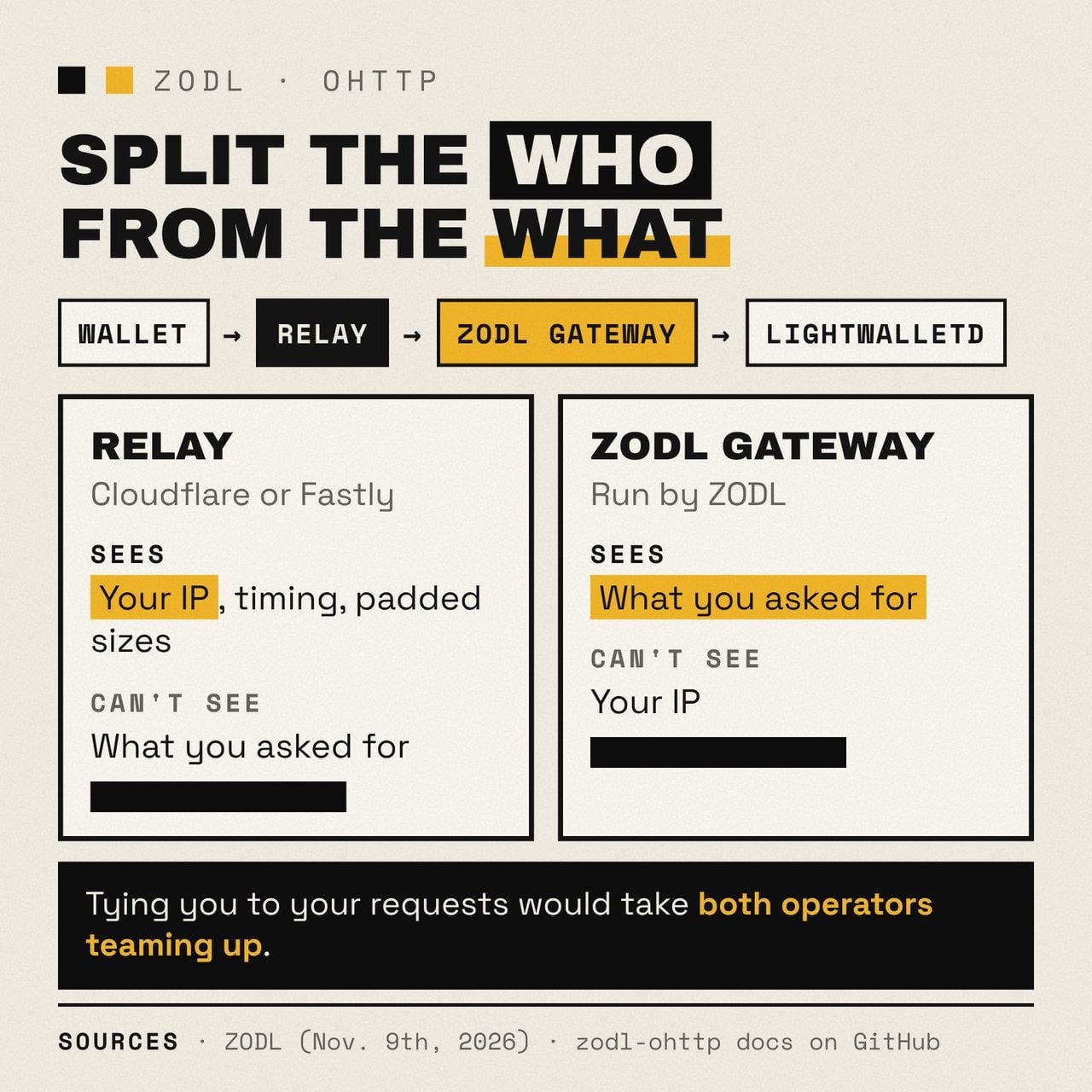
That separation depends on the relay and Zodl not cooperating. The relay can still observe connection times and approximate traffic volume. Zodl core contributor y4ss described OHTTP as a better default, not a substitute for Tor or Nym against a powerful state-level adversary. Users whose concerns include legal pressure on cloud providers can also enable Zodl’s Tor option alongside OHTTP; in that configuration, the relay sees a Tor exit-node address instead of the user’s IP.
The report also describes two safeguards in the published code. Requests are padded into size bands of roughly 4 KB, with transaction broadcasts padded to 16 KB or more; sensitive responses are padded too. Rather than recording relay request IDs in plaintext, the gateway records HMAC-derived values using a rotating key held in memory and lost on restart. These measures aim to make traffic-size analysis and later log matching harder, but they do not remove the design’s trust assumptions. At the time of the report, Zodl planned to roll out the upgrade to users in batches over the following days.
Other approaches to the same leak
The concern extends beyond Zcash. Developer b10c documented an entity called LinkingLion in 2023 that monitored which Bitcoin nodes first broadcast new transactions; its activity appeared to date back to 2018. The report says b10c also observed IP ranges associated with LinkingLion connecting to Monero nodes.
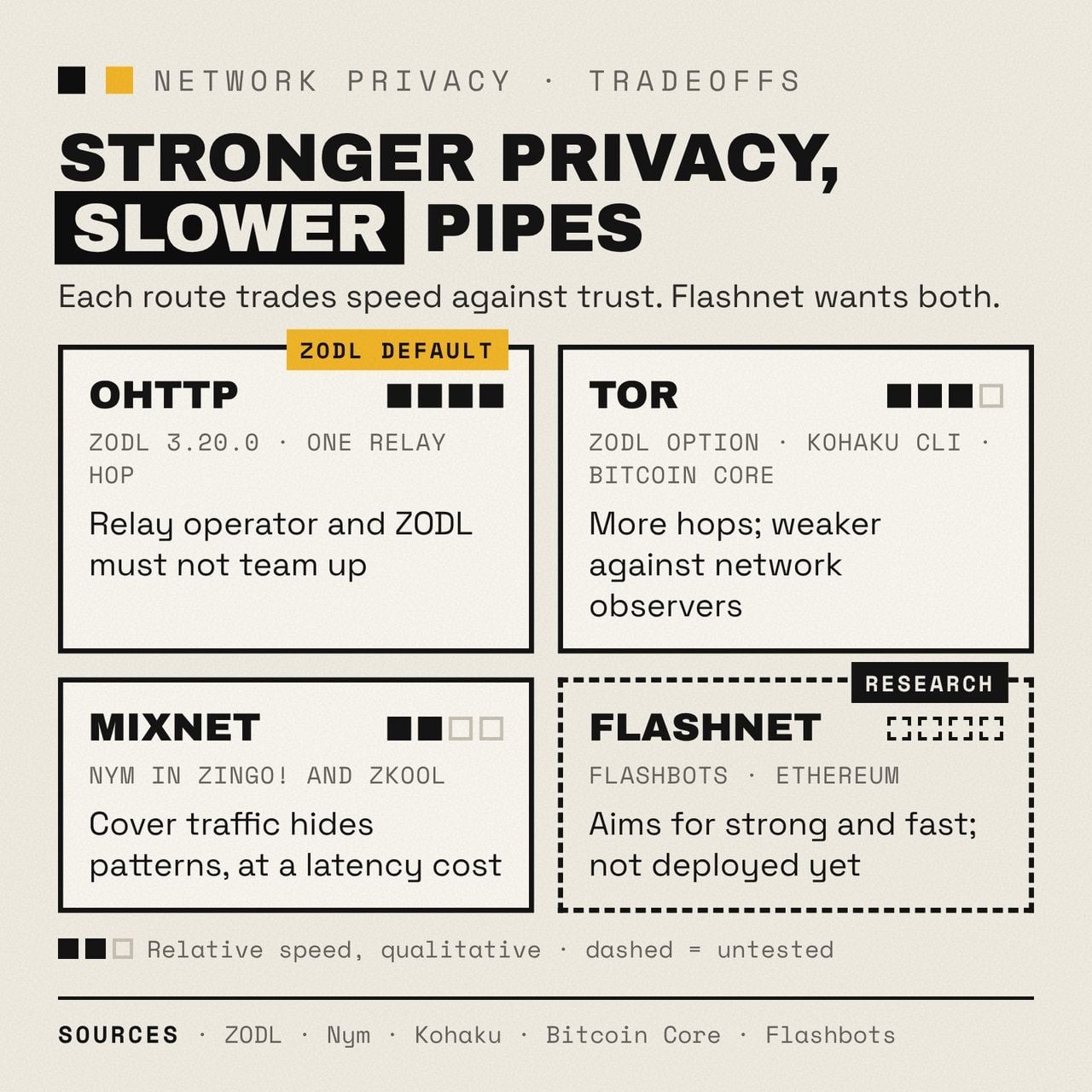
Other projects take different routes, with different costs:
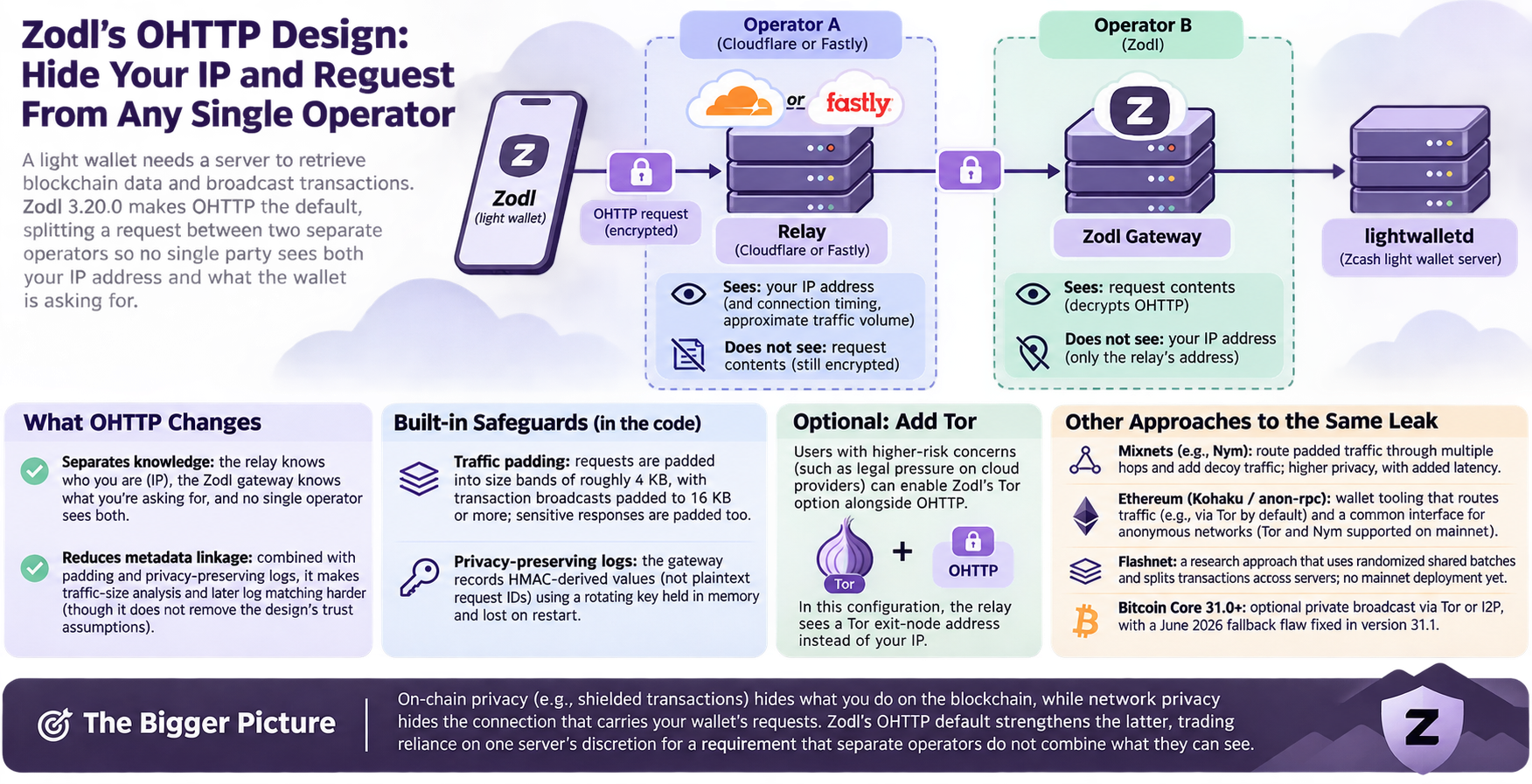
- Mixnets route padded traffic through multiple hops and add decoy traffic to make incoming and outgoing messages harder to match, at the cost of latency. According to a September 2026 update from Nym, Zcash wallets Zingo and Zkool had integrated its mixnet, while Nym was in discussions with Zodl. Nym also announced an SDK at Devcon 8 in the week before the report.
- Ethereum wallet tooling includes a Kohaku command-line tool that routes traffic other than calls to a self-hosted local RPC endpoint through Tor by default. RPC is the interface a wallet uses to request data from a node. The Ethereum Foundation’s anon-rpc proposal, introduced in June 2026, aims to provide wallets with a common interface for anonymous networks. A version supporting Tor and Nym was running on mainnet, and the Privacy Pools v2 web interface had adopted it.
- Flashnet, presented in February 2026 as a research approach to anonymous Ethereum transaction submission, proposes placing transactions in randomized shared-batch slots and splitting them into pieces for reconstruction across servers. The report noted no formal mainnet deployment or benchmark results.
- Bitcoin Core 31.0, released in April 2026, added an optional private-broadcast feature that sends transactions through Tor or I2P using a separate connection for each transaction. Developers disclosed a fallback flaw in June 2026 that could expose the sender’s IP if an anonymous handshake failed; version 31.1 fixed it.
For builders, the distinction is between protecting contract or transaction data on-chain and protecting the network connection that carries a wallet’s requests. Zodl’s change addresses the latter by default, but its relay–gateway split trades reliance on one server’s discretion for a requirement that separate operators do not combine what they can see.