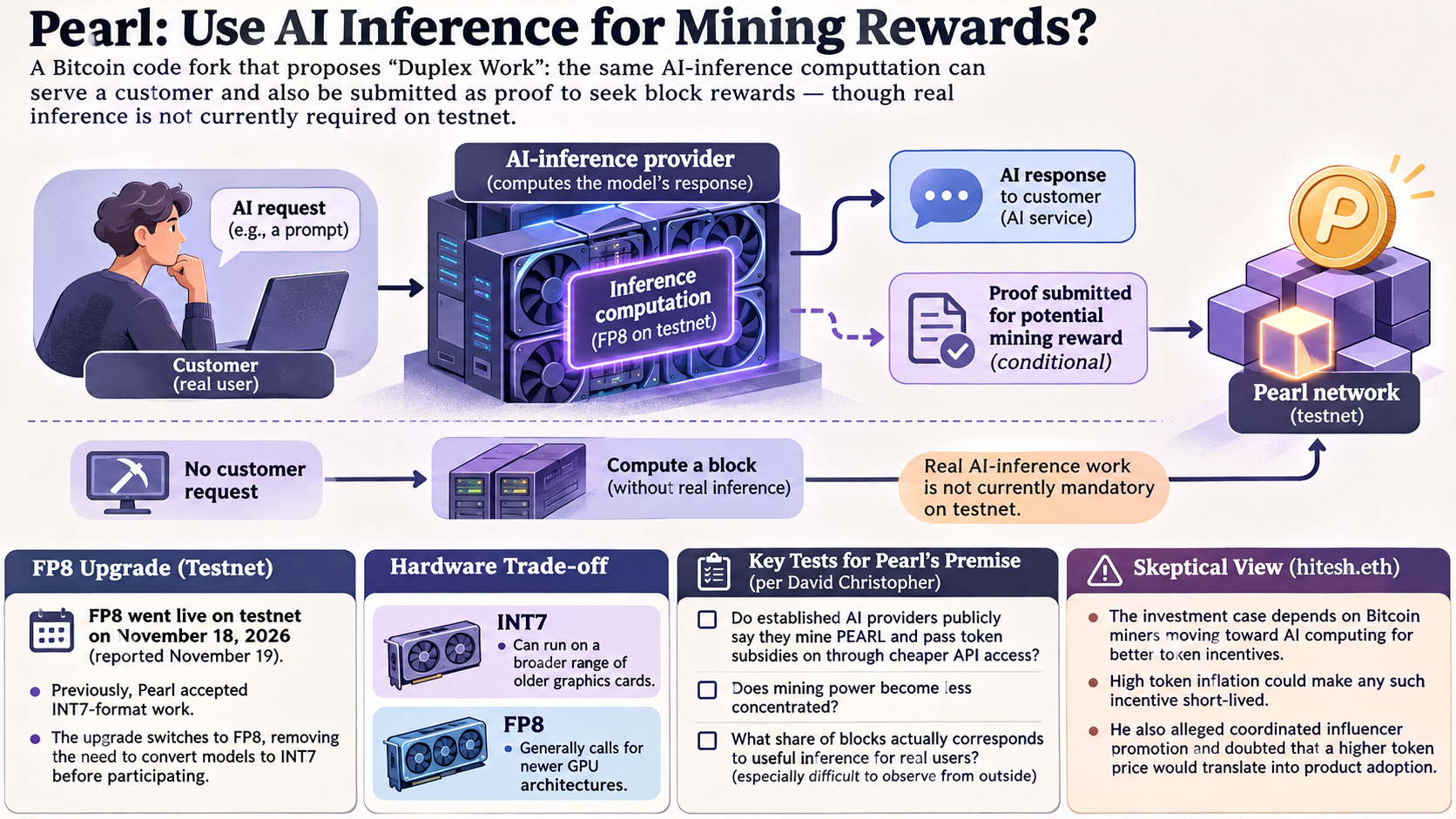
For an AI-inference provider considering Pearl, the practical question is whether work it already performs for customers can count toward mining rewards. Pearl’s FP8 upgrade went live on testnet on November 18, 2026, according to reporting published the following day. That is a testnet change, not evidence that providers have adopted the system.
Pearl is a Bitcoin code fork built around what it calls Duplex Work: providers can submit proofs of AI-inference computations to seek block rewards. Inference is the computation a model performs when responding to a request. The proposed benefit is that a provider could use customer-serving work for both its AI service and mining.
What FP8 changes
Previously, Pearl accepted INT7-format work for this purpose. The FP8 upgrade changes the precision format that can qualify, removing the need for a provider using FP8 to convert its model to INT7 before participating. Bankless analyst David Christopher described FP8 as widely used in commercial inference and said more than 80% of model-inference traffic on platforms such as OpenRouter runs in FP8. That figure is his account, not a measurement established by the testnet launch.
The format switch also brings a hardware trade-off: Christopher noted that INT7 can run on a broader range of older graphics cards, while FP8 computation generally calls for newer GPU architectures.
What the testnet cannot yet prove
Pearl does not currently require miners to submit real AI-inference work. As Christopher explained, miners can still obtain rewards by computing blocks without serving genuine inference requests. FP8 changes which work can qualify; it does not, by itself, verify that a qualifying-looking computation came from a customer task. He said more sophisticated on-chain verification would be needed to address that problem.
Christopher identified three tests for Pearl’s broader premise: whether established AI providers publicly say they mine PEARL and pass token subsidies on through cheaper API access; whether mining power becomes less concentrated; and what share of blocks actually corresponds to useful inference for real users. The last measure is particularly difficult to observe from outside the network.
Crypto researcher hitesh.eth offered a separate, skeptical assessment. He argued that Pearl’s investment case depends on Bitcoin miners moving toward AI computing for better token incentives, and warned that high token inflation could make any such incentive short-lived. He also alleged coordinated influencer promotion and doubted that a higher token price would translate into product adoption. Those are his criticisms, not outcomes demonstrated by the FP8 testnet upgrade.