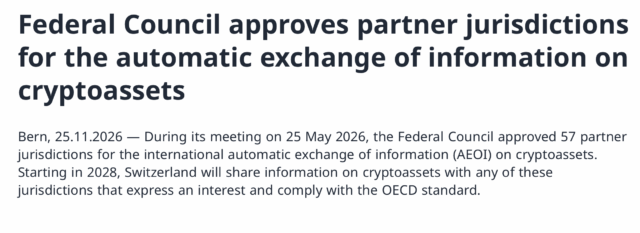
Switzerland’s Federal Council approved 57 potential partner jurisdictions on November 25, 2026, for automatic sharing of crypto tax information beginning in 2028. The decision creates no new crypto tax. It changes how tax authorities could obtain records from overseas exchanges without first investigating an individual account.
Approval of the list does not activate an exchange of records with every jurisdiction. Each partner’s participation depends on its authorities’ interest and compliance with international reporting standards. Switzerland had postponed implementation while lawmakers considered which partners to include. The State Secretariat for International Finance said implementation could begin no earlier than January 1, 2027. That is distinct from the planned start of international data sharing in 2028.
What a Swiss exchange could report
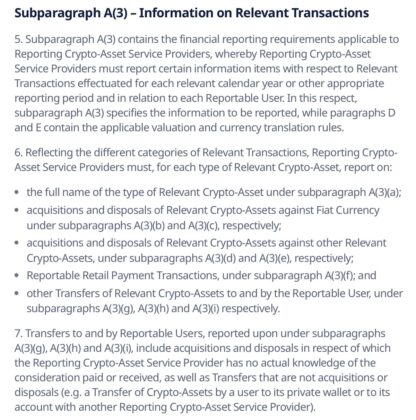
Under the Organisation for Economic Co-operation and Development’s Crypto-Asset Reporting Framework (CARF), covered service providers must identify customers’ tax residency and report relevant activity. If a customer is reportable to a partner jurisdiction and its arrangement with Switzerland is active, that jurisdiction’s tax authority could receive records from the customer’s Swiss exchange account. Identifying details can include a name, residential address and tax identification number.
The framework covers more than sales for fiat currency. Swapping bitcoin for a stablecoin, transferring crypto between platforms or receiving certain crypto distributions may also generate reportable records. Whether a transaction creates a tax liability is a separate question governed by domestic law.
Where private wallets fit
Withdrawing bitcoin to a wallet whose keys the customer controls does not erase the exchange’s record of an earlier trade. The OECD’s commentary also includes certain transfers from a reporting provider to a customer’s private wallet, so the withdrawal itself may be reportable. That does not give tax authorities control of the wallet’s private keys or make every later wallet transaction reportable. The requirement applies to the intermediary; it does not change how the Bitcoin network operates.
The State Secretariat describes the aim as ensuring “equal treatment of the crypto sector with the traditional financial sector.” Accuracy and security matter because the records link identities to financial activity. An incorrect tax-residency classification can affect which authority receives a record, and reconciling historical costs can be difficult when assets have moved through several exchanges and private wallets. As Switzerland implements the requirements and activates individual arrangements, safeguards against unauthorized disclosure and procedures for correcting errors will matter alongside guidance for reporting providers.