Coinbase shares traded below $102 on November 25, 2026, more than 60% below their $263 high for the year and about 77% below their all-time high of $444.60. A report published that day at 21:45 UTC+8 highlighted the challenge facing the exchange: its share of global crypto trading had nearly doubled to 10.7% over the preceding year, but volume in its lucrative US retail spot business had fallen nearly 60% year over year.
The third-quarter accounts show why that shift matters. Coinbase reported $719 million in net income, of which $715 million, or 99.5%, came from unrealized gains on crypto assets held for investment. Net transaction revenue fell 44% year over year, and adjusted net income fell 82% to $77.7 million. Coinbase still had a cumulative net loss for the first nine months of 2026.
Fourth-quarter transaction revenue totaled about $165 million through October 25. Coinbase expected adjusted expenses for the full quarter to exceed $1 billion, up from $975 million in the third quarter. Bitcoin, meanwhile, had recorded seven consecutive weekly declines and remained below $60,000.
Buybacks offset much of the new share issuance
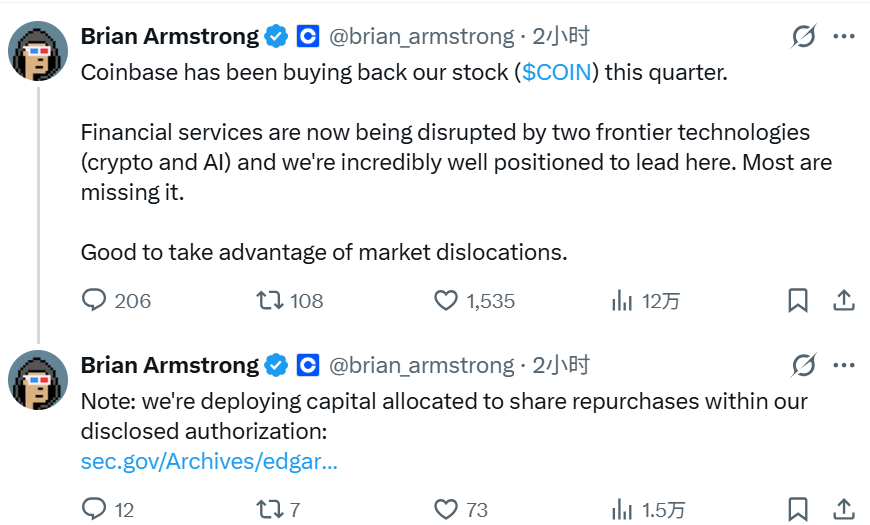
On November 25, CEO Brian Armstrong said on X that Coinbase had been buying back shares during the quarter under its existing authorization. He said crypto and AI were reshaping financial services and that he saw a mismatch between market prices and that opportunity.
SEC filings showed that Coinbase bought about 38,000 shares in the third quarter at an average of $139.91, spending approximately $5.316 million. Cumulative repurchases reached about 10.17 million shares at a cost of roughly $2 billion.
Those purchases offset more than 85% of shares issued since the fourth quarter of 2024, but they did not eliminate dilution from equity compensation. The share count rose from 263 million in the first quarter of 2026 to 265 million in the third. Executives also sold shares under scheduled Rule 10b5-1 plans.
Options and margin trading expand, with limits on US access
After completing the integration of INTX and Deribit in October, Coinbase opened Bitcoin and Ether options backed by Deribit liquidity to eligible non-US customers on November 19. US institutions could access the options through Coinbase Prime, while US retail customers remained on a waiting list. Coinbase had warned that trading volumes could fluctuate during the migration.
Coinbase Advanced also introduced spot margin trading, which lets customers borrow against collateral to trade. It offered up to 10 times leverage on major assets and around five times on others. Customers could use more than a dozen types of collateral and share margin across spot and derivatives positions. US individuals faced a $10 million threshold in discretionary investments to qualify as eligible contract participants, as well as restrictions based on state and intended use.
Coinbase planned to relaunch Coinbase Pro by the end of 2026 with one account for spot assets, futures, perpetual contracts, options and stocks. The fee trade-off is important: lower-fee professional and derivatives trading, like the zero-fee spot offering on Coinbase One, can attract volume without replacing the revenue Coinbase previously earned on US retail spot trades.
Coinbase plans to bring prediction-market clearing in-house
The prediction-market business had exceeded $200 million in annualized net revenue, not revenue collected over a full year. Activity outside the sports season remained dependent on cyclical contracts, including those tied to crypto volatility. Kalshi supplied most contracts, and the report attributed part of Coinbase’s third-quarter transaction expense ratio of 16.8% of net revenue to fees shared with external exchanges as prediction trading grew.
Bloomberg reported that Coinbase planned to launch its own prediction market for US retail and institutional customers in the first half of 2027. Coinbase acquired The Clearing Company in 2025 and obtained registration for Coinbase Clearing in September 2026.
The proposed design would keep customer collateral on the platform in USDC and clear contracts internally. If implemented, it could allow Coinbase to earn trading fees and interest from US Treasuries backing USDC. The launch was still a plan, with uncertainty over state and federal regulatory authority and the potential implications of litigation involving Kalshi.
On Base, tokenized stocks can serve as loan collateral
DefiLlama put the total value locked in Base protocols at $4.95 billion. According to official Base figures, tokenized stocks had generated more than $1 billion in cumulative trading volume since launch. Coca-Cola and Walmart were among the stocks added in November.
The distinction from a zero-commission stock trade on Robinhood is what holders can do after a purchase. Holders had deposited a substantial share of tokenized US stocks into lending protocols such as Aave, where the tokens could serve as collateral even when US stock markets were closed. That ability to use an asset in another protocol is called composability. Coinbase’s broader plans for the Base App included perpetual contracts, prediction markets, payments and automated settlement for AI agents.
A Base token was a separate question. In a November 22 interview, Base lead Jesse Pollak said the team was still exploring the possibility but was in no hurry to issue one because it did not want to distract from platform growth. Armstrong indicated he would devote more attention to customers and products, pointing to 2027 as an important period for delivery. Whether those businesses could make up for lost retail spot revenue remained open.