Investors had withdrawn a net $4.71 billion from U.S. spot Bitcoin exchange-traded funds (ETFs) in November by the time of the November 25, 2026 report. That was already the largest monthly net outflow since the funds launched and about 9.2 times October’s $510 million, according to SoSoValue. Combined net outflows from spot Bitcoin and Ether ETFs exceeded $8.06 billion in the fourth quarter to date.
BlackRock funds account for most of the net outflows
BlackRock’s IBIT recorded more than $4.17 billion in November net outflows after several consecutive months of net inflows. It accounted for 88.5% of the Bitcoin funds’ net outflow for the month to date. Across all spot Bitcoin ETFs, fourth-quarter net outflows exceeded $5.22 billion. Nearly $570 million flowed out at the start of the reporting week, more than a third of the previous week’s net outflow. Bitcoin had fallen below $60,000 without a clear return to net buying through the funds.
For spot Ether ETFs, October was the record month: net outflows reached $1.61 billion, with the week of October 9 recording the year’s second-largest weekly net outflow. Fourth-quarter net outflows exceeded $2.84 billion after several months of net inflows. BlackRock’s ETHA accounted for about $2.44 billion, or 85.9%, of the quarter’s net outflow.
What the third-quarter filings show
Galaxy Research’s analysis of Form 13F holdings disclosures showed that institutional investment managers increased their U.S. spot Bitcoin ETF positions by the equivalent of 49,229 BTC in the third quarter. That more than reversed the combined reduction of 47,054 BTC over the preceding three quarters. Reported holdings reached a record 356,491 BTC, then worth about $29.8 billion. Bitcoin rebounded as high as $87,000 during the period.
Galaxy research head Alex Thorn said several dozen large institutions drove the increase. Investment advisers and wealth management platforms accounted for half the net increase in ETF shares. Bloomberg ETF analyst James Seyffart said more than 2,200 institutions held Bitcoin ETFs as of September 30, with Wells Fargo the largest institutional holder. Advisers predominated among those disclosing positions, a sign Seyffart viewed positively because advisers typically hold investments longer.
The filings describe holdings at quarter-end and are disclosed with a lag. They do not establish which of those institutions sold during the subsequent outflows.
Paper losses are distinct from withdrawals
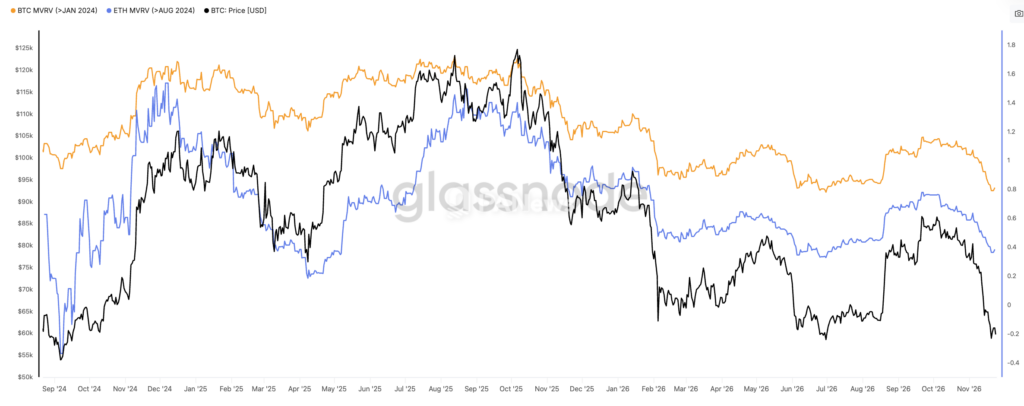
As of November 23, Glassnode put the market-value-to-realized-value ratio (MVRV) at 0.81 for U.S. spot Bitcoin ETFs and 0.38 for spot Ether ETFs. The ratio compares the market value of holdings with their cost basis. A reading below 1 indicates an aggregate paper loss, not a loss realized through sales.
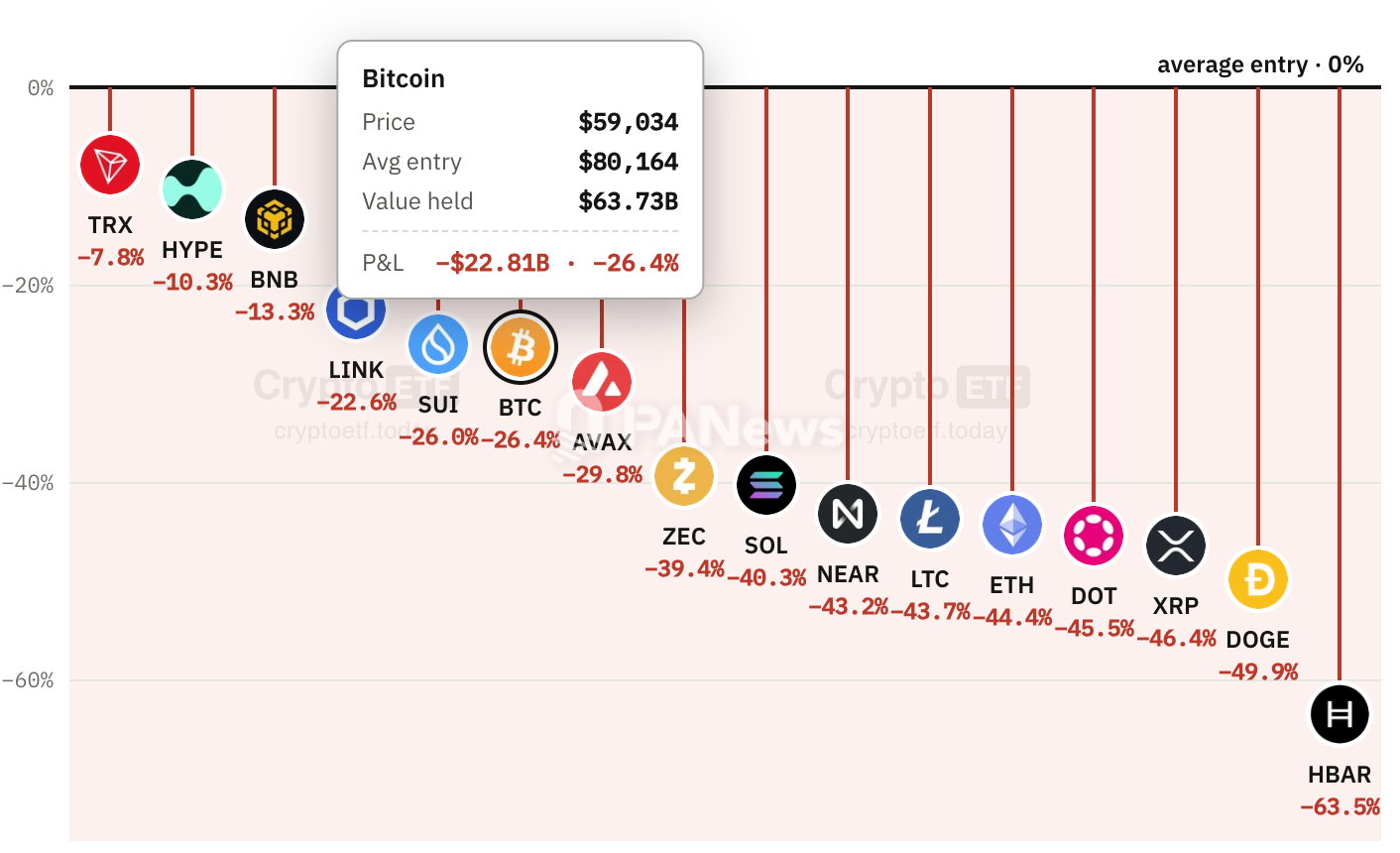
CryptoETF.today separately estimated that Bitcoin ETF investors had an average cost of $80,164 per BTC on November 23, about 35.7% above the Bitcoin price at the time, and an aggregate unrealized loss of about $22.76 billion. For Ether ETFs, it put the average cost at $2,974 per ETH against a market price of $1,655, with unrealized losses of about $7.18 billion.
Outside the funds, two publicly traded crypto treasury companies also faced paper losses: more than $14.1 billion on Strategy’s Bitcoin holdings and more than $10.3 billion on BitMine’s Ether holdings. Those figures measure declines in the value of corporate holdings, not money withdrawn from ETFs.