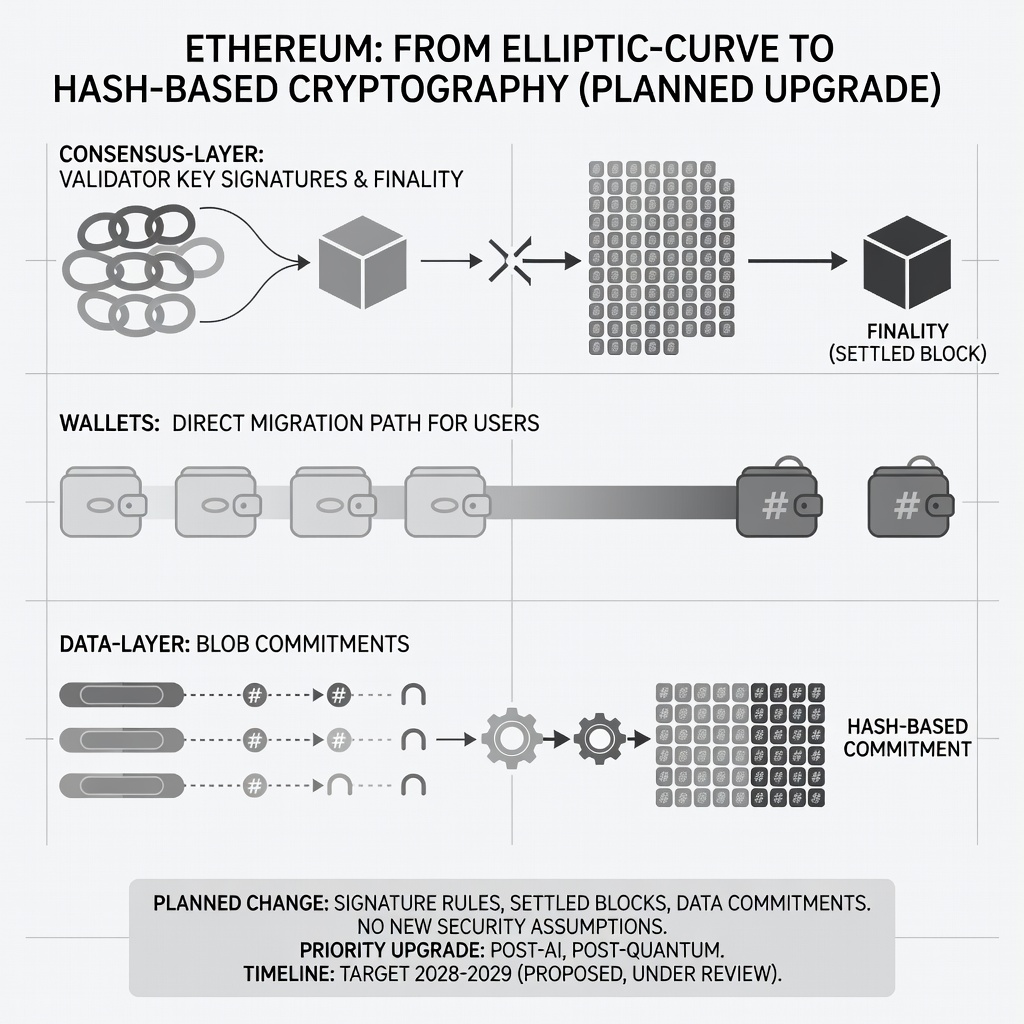
For builders, the immediate task is not a new contract language or a deployment step in a workshop IDE. It is to separate today’s signature rules from a planned change in what Ethereum treats as a valid signature, a settled block, and a data commitment.
The Ethereum Foundation’s official blog says it will replace elliptic-curve cryptography with hash-based cryptography and has made that “post-AI, post-quantum” upgrade Ethereum’s highest priority. Elliptic-curve cryptography is the math family behind many current blockchain signatures. Hash-based cryptography instead rests on hash functions, which compress data into fixed fingerprints. The post, reported on 24 November 2026, calls this upgrade harder and on a tighter schedule than the Merge completed on 15 September 2022, while saying the foundation now has stronger tools than it had then.
The blog describes three parts. They are a plan, not changes the post presents as already active on mainnet.
- Consensus-layer validators would move to hash-based key signatures, so finality — the point at which the network treats a block as settled — would no longer depend on elliptic curves.
- Wallets would offer users a direct path to migrate to hash-based signatures.
- Data-layer blobs, the protocol’s bulk data objects, would switch to hash-based commitments.
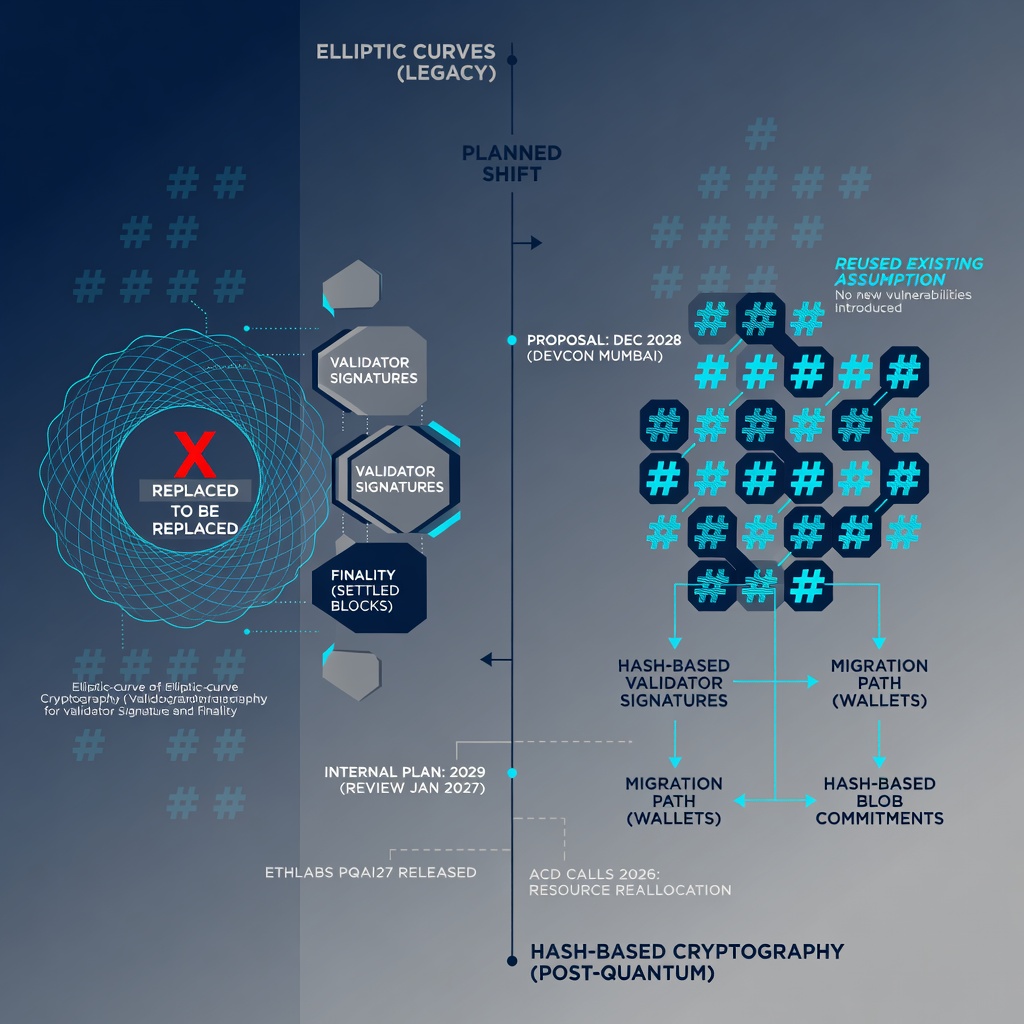
The foundation says that after more than a year of evaluating candidate signature schemes, it favors hash-based cryptography because the Ethereum protocol already depends on hash security. On that account, the move does not introduce a new security assumption. To match the development pace, the foundation has doubled the protocol security team.
The dates are a proposal and an internal plan, not an enacted schedule. At Devcon in Mumbai, Justin Drake proposed December 2028 as the target. The foundation’s internal plan sets 2029 as the latest time, and it plans to review the timeline in January 2027.
Some engineering steps are already reported as underway. Ethlabs has released pqai27 and has withdrawn its Quick Slots proposal from the Hegotá fork to free engineering resources. The first pq-cl development network has started iterating. The remaining ACD calls in 2026 — All Core Developers calls, where client teams discuss protocol work — are to consider whether more features should be removed from that fork.
Nothing in the announcement changes a compiler, a deployment workflow, or current mainnet rules. The surfaces it names for later migration are validator signing, wallet keys, and blob commitments. That path is a stated priority, not a completed upgrade, and no compilation, audit, or mainnet result is claimed for it.