For wallet and smart-contract builders, the difficult part of preparing for quantum computers is not simply choosing a new signature algorithm. It is finding a way for people to retain control of existing accounts and assets while the rules for authorizing transactions change.
As reported on November 19, 2026, the Ethereum Foundation had formed a Post-Quantum Security team. Protocol priorities it published that September set a target—not a completed upgrade—of making Ethereum L1 resistant to quantum attacks across its execution, consensus and data layers by December 2029. The source reported that no quantum computer capable of breaking the cryptography in question existed at the time.
Why the risk differs between accounts
Ethereum’s ordinary externally owned accounts (EOAs) use ECDSA signatures. A sufficiently capable, fault-tolerant quantum computer running Shor’s algorithm could, in theory, derive a private key from an exposed public key and forge signatures. Validator signatures based on BLS face a related long-term problem.
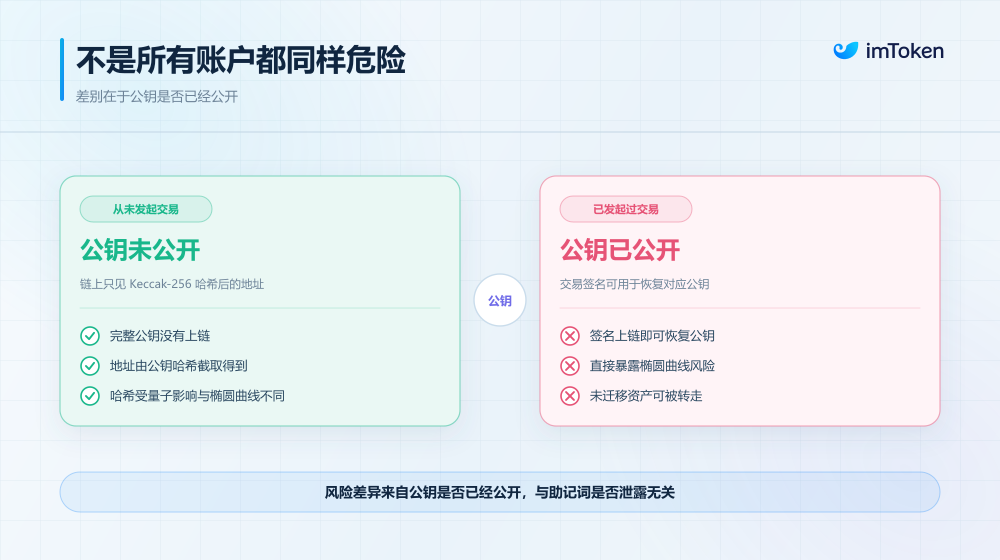
An EOA address is derived by hashing its public key with Keccak-256 and truncating the result. If an account has never sent an on-chain transaction or disclosed an off-chain signature, its full public key may not have been exposed. Once it signs a public transaction—including a token approval—the signature allows its public key to be recovered. That distinction matters to an account’s potential exposure; it does not mean users need to move assets urgently. Hash functions such as Keccak-256 are more resilient to the quantum attack described here than elliptic-curve signatures.

The engineering work under discussion
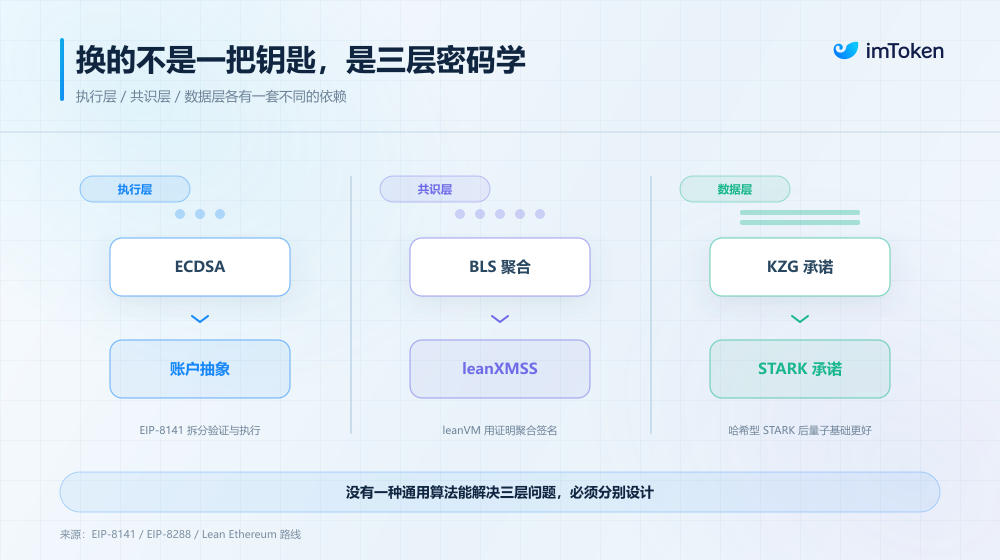
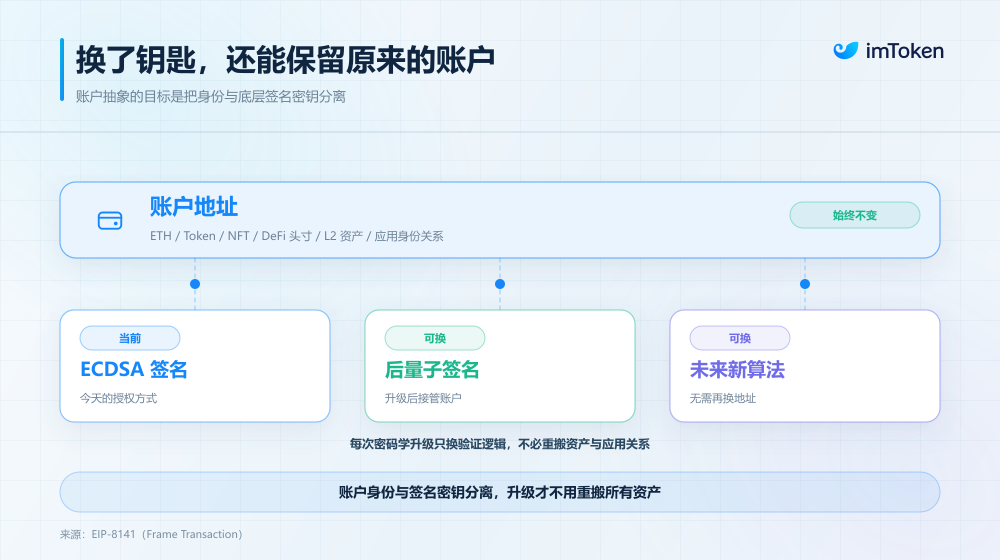
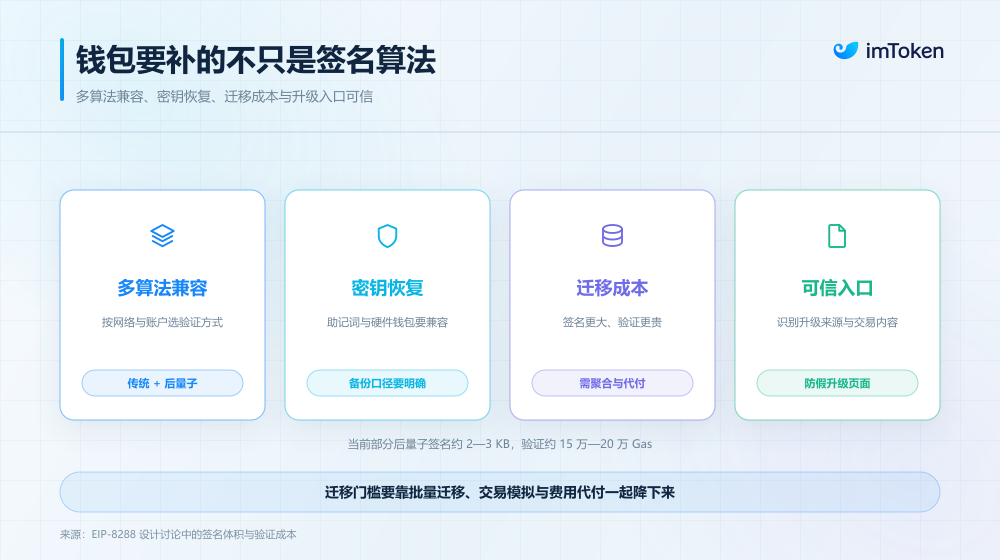
On the execution layer, EIP-8141 is a proposal, not an active account rule. It would separate transaction validation, execution and gas payment into different steps. Programmable validation could give accounts a path to change keys or signature schemes without always changing addresses. Work on post-quantum signature-verification precompiles is also under consideration. Because post-quantum signatures can be much larger than today’s signatures, EIP-8288 proposes using recursive STARK proofs to aggregate verification results and reduce on-chain costs.
On the consensus layer, the Lean Ethereum direction explores leanXMSS, a hash-based signature scheme intended to replace validators’ BLS signatures, and leanVM, a proposed way to aggregate their verification into compact proofs. These are engineering directions, not changes already deployed across Ethereum.
The data layer presents a separate problem: KZG commitments used with blobs and rollup data availability rely on elliptic-curve assumptions. Some pairing-based SNARK proofs do too. Hash-based STARKs do not rely on the same elliptic-curve discrete-logarithm assumption. A transition would therefore have implications beyond wallet signatures, including for rollups and other applications.
The account-migration problem
A new key does not automatically grant control of assets and permissions associated with an old address. An EOA owner may have tokens, NFTs, DeFi positions, L2 assets and application permissions to consider. Programmable accounts could potentially let a user update validation rules while retaining an address, but that is a prospective capability, not a universal migration path available today.
The safer theoretical sequence is to authorize a new key while the old signature scheme can still establish ownership. If both an attacker and the owner could forge signatures under the old scheme, that authorization would no longer reliably distinguish them. Dormant accounts and lost keys pose further unresolved questions. Wallet developers would also need to make any eventual migration process clear enough that users can identify legitimate authorization requests rather than fraudulent “upgrade” prompts.