
For developers planning a large token distribution, the question is whether to write balances to many addresses up front or let recipients claim them. In a report published on November 16, 2026, TechFlow described Vitalik Buterin’s response to concerns that a proposed increase in Ethereum storage costs could make large airdrops more expensive.
The proposed storage change
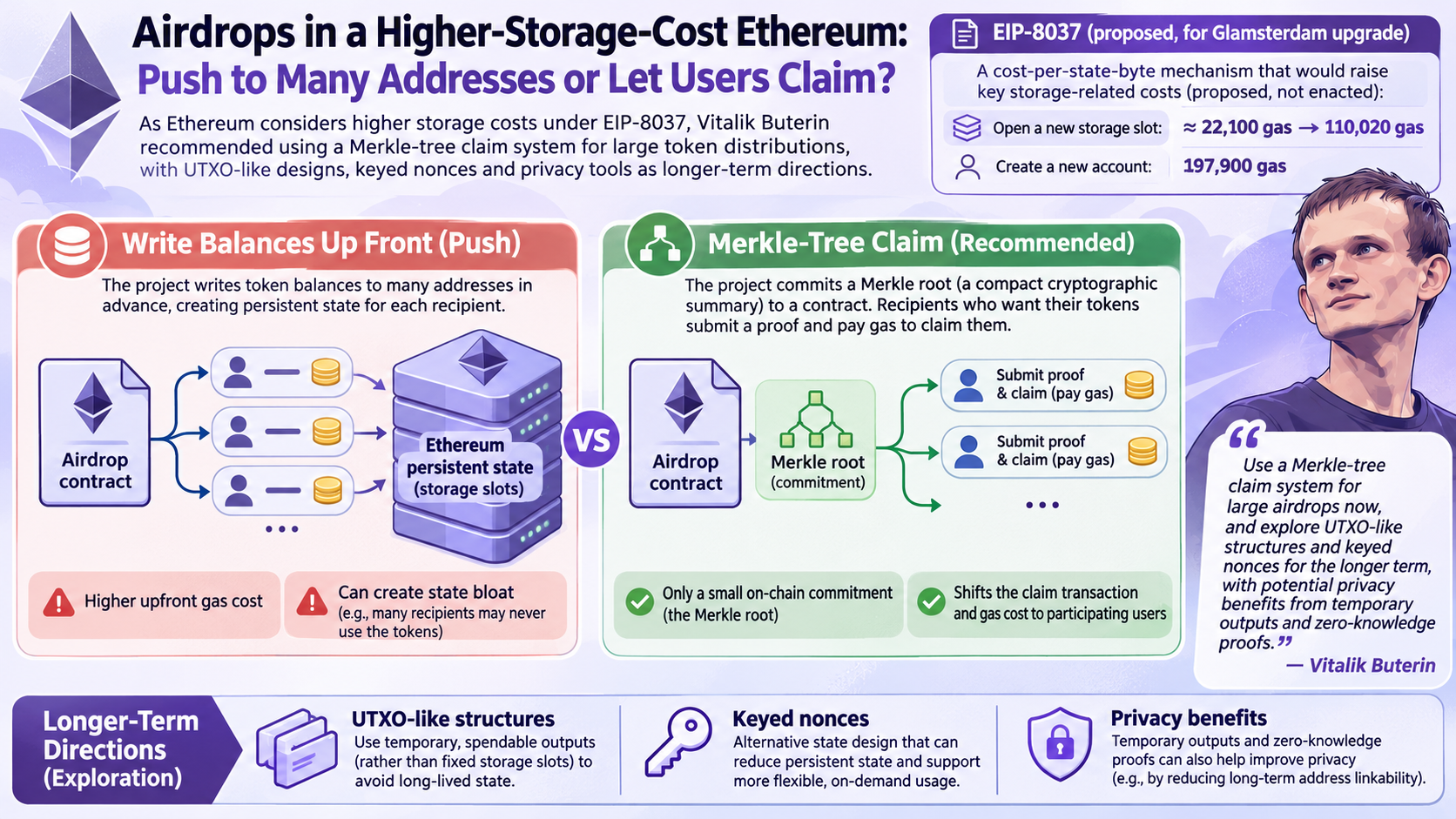
TechFlow reported that EIP-8037, a proposal being advanced for the Glamsterdam upgrade, would introduce a cost-per-state-byte mechanism. Under the proposal, opening a new storage slot would rise from about 22,100 gas to 110,020 gas, while creating a new account would cost 197,900 gas. These are proposed costs, not enacted rules.
The concern is state bloat: data written to Ethereum’s persistent state must continue to be maintained by nodes. Writing balances to hundreds of thousands of addresses for an airdrop can create state even for recipients who never use the tokens.
Claiming instead of pushing
According to TechFlow, Buterin pointed to a Merkle-tree claim system as a near-term alternative. Rather than writing every recipient’s balance in advance, a project commits a Merkle root—a compact cryptographic summary—to a contract. Recipients who want their tokens then submit a proof and pay gas to claim them. This shifts the claim transaction to participating users and avoids creating balances in advance for addresses that never claim.
For the longer term, TechFlow said Buterin had discussed exploring UTXO-like structures and keyed nonces as alternatives to fixed storage slots, alongside possible privacy benefits from temporary outputs and zero-knowledge proofs. Those ideas are longer-term directions, not changes delivered by EIP-8037.