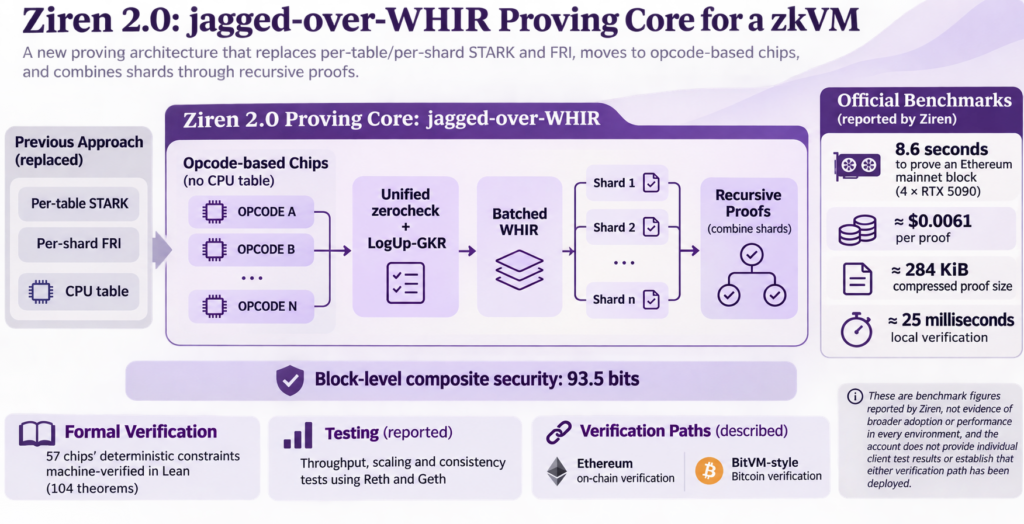
For builders examining how a zkVM proves execution, the change reported in Ziren 2.0 is its proving core. As reported on November 4, 2026, the release replaces the previous per-table and per-shard STARK and FRI approach with jagged-over-WHIR, using unified zerocheck, LogUp-GKR and batched WHIR. It also removes the CPU table in favor of opcode-based chips and combines shards through recursive proofs.
Ziren’s official benchmarks report an average of 8.6 seconds to prove an Ethereum mainnet block using four RTX 5090 GPUs, at approximately $0.0061 per proof. The reported compressed proof size is approximately 284 KiB, with local verification taking approximately 25 milliseconds. These are benchmark figures, not evidence of broader adoption or performance in every environment.
The release says the deterministic constraints of 57 chips were machine-verified in Lean across 104 theorems, and gives 93.5 bits as the block-level composite security figure. It also reports throughput, scaling and consistency tests using Reth and Geth, and describes Ethereum on-chain verification and a BitVM-style Bitcoin verification path. The supplied account does not provide the individual client test results or establish that either verification path has been deployed.