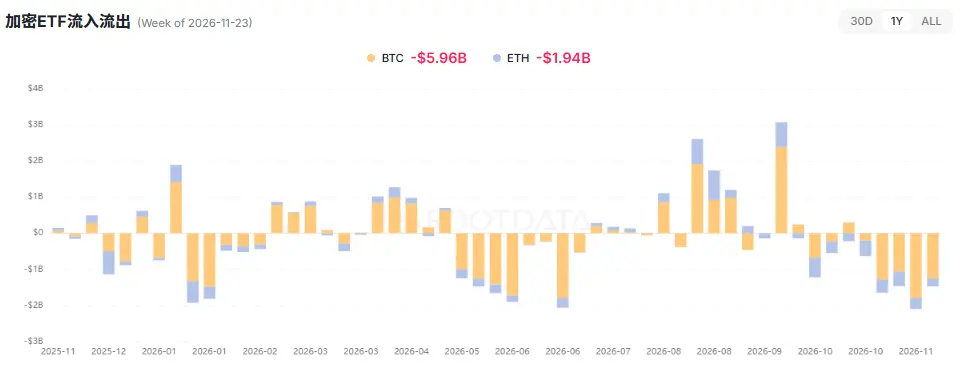
US spot Bitcoin exchange-traded funds (ETFs) recorded $5.7 billion in net outflows from November 1 through November 25, 2026, according to RootData. With five days left in the month, withdrawals had already surpassed June’s full-month record of $4.51 billion. Net outflows for the year stood at about $5.96 billion.
Bitcoin fell below $60,000 in November, reaching its lowest price since September 2024. Futures positioning suggests that investors closing hedged trades cannot fully explain the withdrawals. But the available disclosures identify only a fraction of ETF holders, leaving open the question of who sold.
What the holdings data can—and cannot—show
One reason to buy a spot ETF is to pair it with a short futures position and capture the price difference between the two. Closing that basis trade can mean selling ETF shares without expressing a view on Bitcoin’s price.
By November 17, leveraged funds’ net short position in CME Bitcoin futures had fallen to about 1,211 contracts, equivalent to roughly 6,000 BTC, according to US Commodity Futures Trading Commission data. That was more than 90% below the December 2024 peak. With much of the basis trade apparently unwound by early November, 10x Research said the continued ETF withdrawals looked more consistent with investors steadily reducing their Bitcoin exposure.
Investment advisers and wealth platforms were the largest group in third-quarter Form 13F holdings disclosures, accounting for about 40.5% of reported holdings. But the filings covered only 27.6% of the Bitcoin held by the funds. The next disclosures, due in February 2027, will offer only a partial view of who reduced their positions.
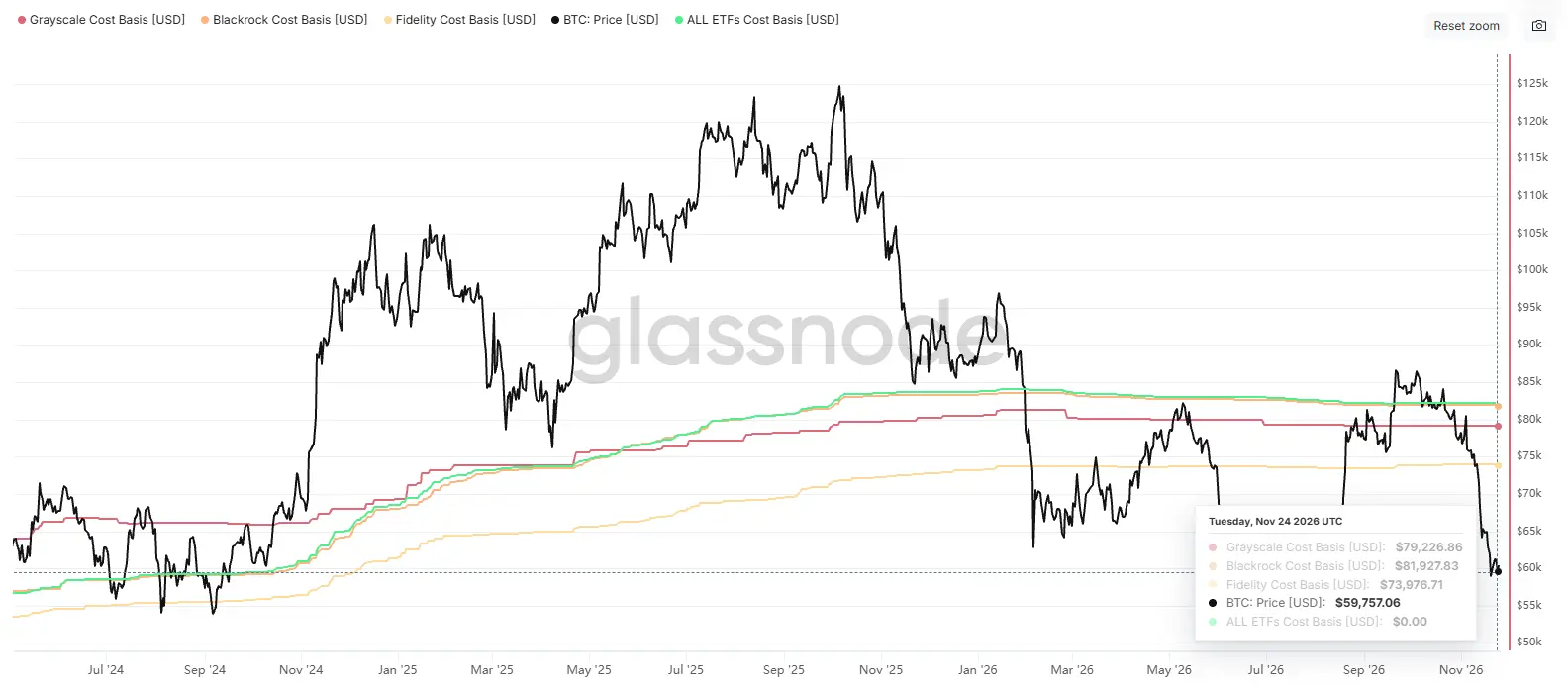
On November 24, Bitcoin traded at about $59,757. Glassnode estimated the average holder’s cost at $81,928 for BlackRock’s IBIT, $79,227 for Grayscale and $73,977 for Fidelity. For the average IBIT holder, that implied an unrealized loss of about 27%; it does not establish that those holders sold.
Bitcoin fell with equities but missed their recovery
The Federal Reserve’s September rate increase, its first in three years, marked the first rate-hiking cycle for US spot Bitcoin ETFs since their launch nearly three years earlier. On October 28, the Fed held its target range at 3.75%–4% without signaling a reversal. Bitcoin ETFs posted net outflows on 14 of the next 17 trading days, according to 10x Research.
On November 5, a sell-off in AI stocks pushed the Nasdaq 100 down 6.36%, while Bitcoin fell about 5.5%. Inflation data came in above expectations on November 10. After the Fed released its meeting minutes on November 18, CME FedWatch put the probability of a December rate increase near 95%. A quarter-point increase was widely expected, not decided; the Fed’s guidance on rates in 2027 also remained open.
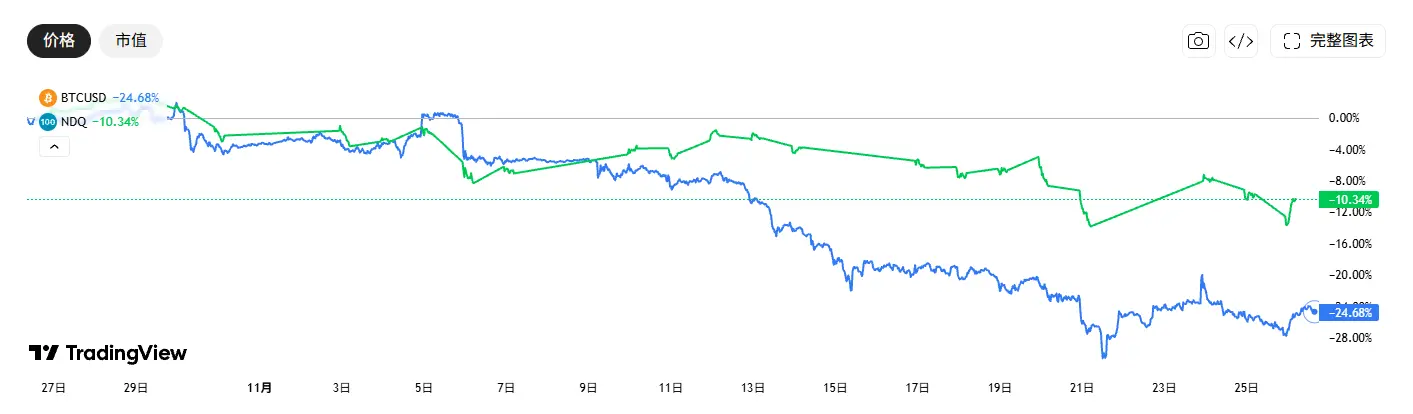
Since October 28, Bitcoin had fallen about 25%, against roughly 10% for the Nasdaq 100. Glassnode noted that US equities recovered above their election-day close, while Bitcoin fell again after the inflation release. Several developments specific to crypto complicated the comparison:
- Exchange security: On the first trading day after the reported theft of about $6.3 billion from Binance, spot Bitcoin ETFs recorded roughly $640 million in net outflows, the most in a day since late June. ViaBTC chief analyst Jeff Ko saw the reaction primarily as a loss of confidence: the ETFs’ Bitcoin was held by regulated custodians, with no direct link to Binance. OneKey’s Yishi raised a separate custody question, noting that Coinbase held most of IBIT’s roughly 760,000 BTC and that its $320 million insurance coverage amounted to less than 1% of the value of IBIT’s holdings.
- Legislation: Democrats won both chambers of Congress in the November 3 midterms. CertiK’s Stefan Muehlbauer judged that the proposed CLARITY Act would be difficult to pass in either the sitting Congress or the next one.
- Index membership: On November 11, MSCI announced that it would remove Strategy, the largest Bitcoin treasury company, from its indexes. The removal of Strategy, Metaplanet and Upexi was scheduled to take effect after the November 30 close. JPMorgan had estimated about $2.8 billion in potential passive selling. Strategy argued the effect would be limited because the relevant funds held only about 3.1% of its shares.
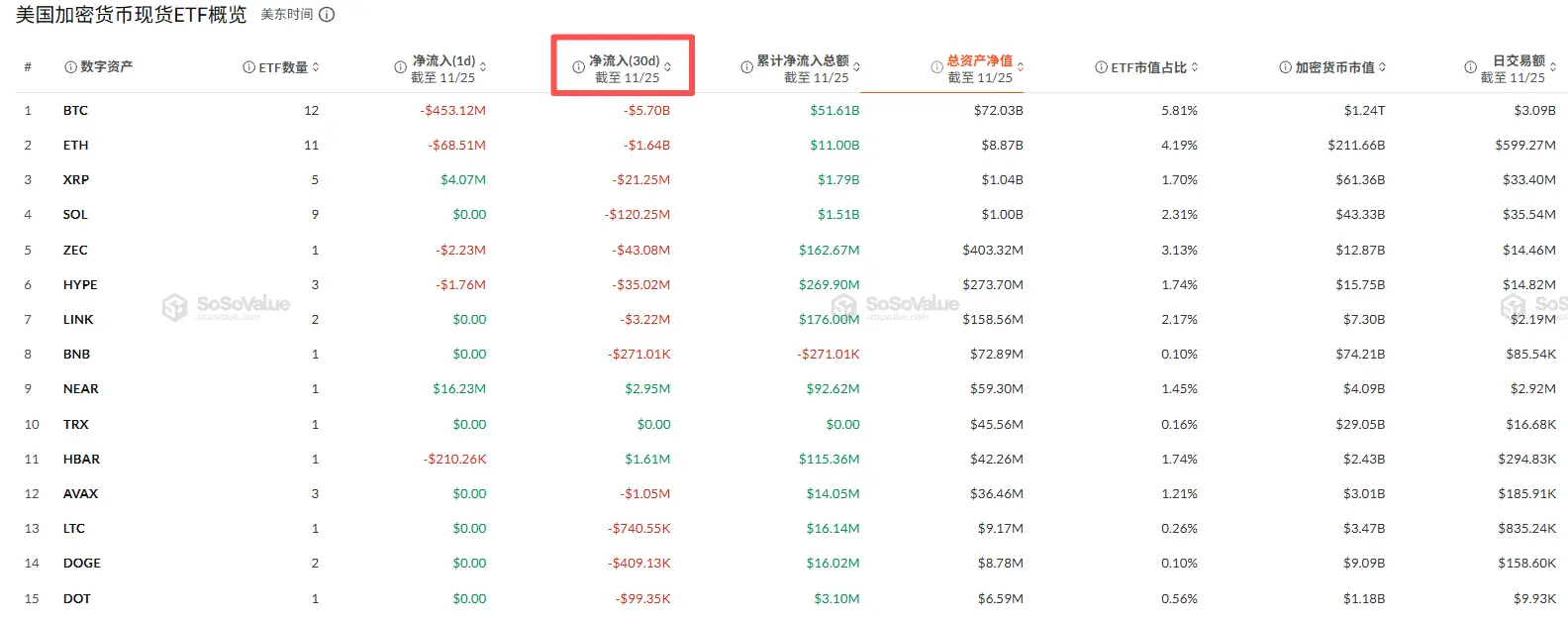
Withdrawals extended beyond Bitcoin. In November 2025, newly listed Solana and XRP ETFs attracted money as Bitcoin and Ether funds lost it. In October 2026, Solana ETFs shifted to net outflows after 14 consecutive weeks of net inflows. According to SoSoValue, 12 of 15 US spot crypto ETF categories recorded net outflows over the latest 30 days, including $1.64 billion from Ether ETFs.
Corporate buyers offered little offset
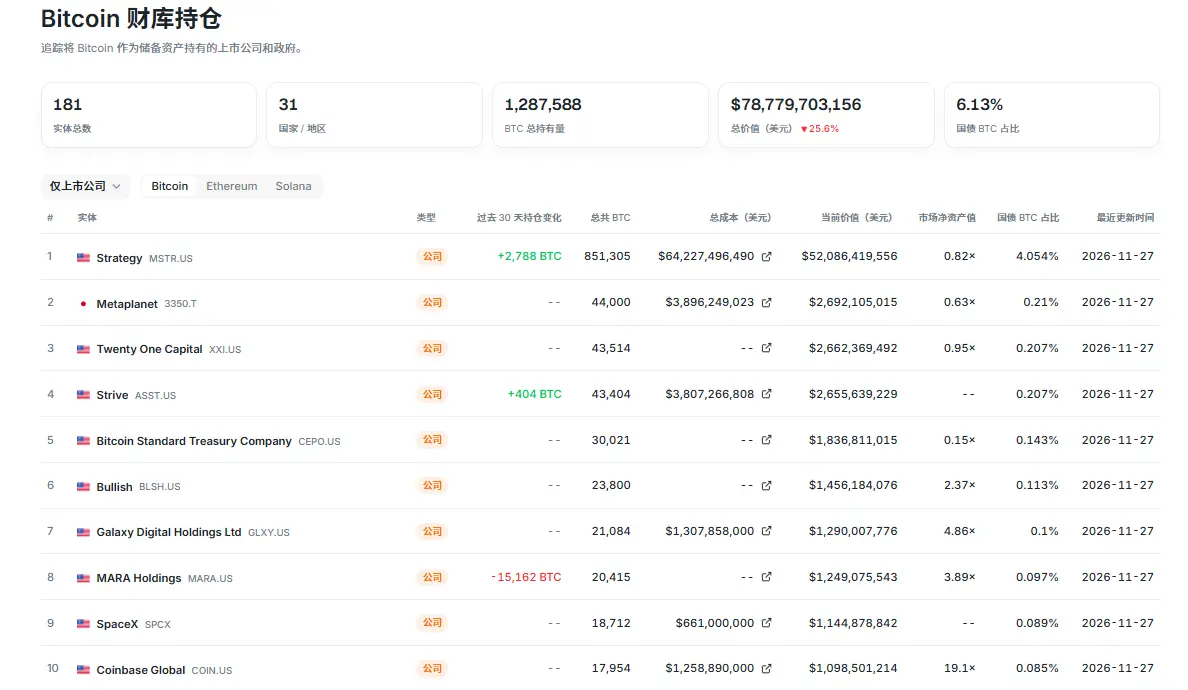
RootData put Strategy’s holdings at 851,305 BTC, acquired at an average price of about $75,000, implying an unrealized loss of roughly 20%. Its market valuation stood at 0.83 times net asset value, and it added only 2,788 BTC over 30 days. In late May, Strategy sold 32 BTC to pay preferred-stock dividends, its first Bitcoin sale since December 2022.
Bitcoin miner MARA said in its third-quarter shareholder letter that it had sold 13,597 BTC after the quarter ended, raising about $1.1 billion. It said it would continue selling to fund projects including AI infrastructure. Over a separate 30-day window, RootData recorded a 15,162 BTC decline in MARA’s holdings.
Stablecoin market capitalization also fell, dropping about $16 billion, or 5.58%, over 30 days to $273.09 billion, according to rwa.xyz. Coinkarma founder Benson Sun said that although he considered longer-term indicators favorable, both stablecoin and ETF flows remained negative over 30 days. He said he would wait for ETF flows to turn positive before buying.
Three precedents do not establish a price floor
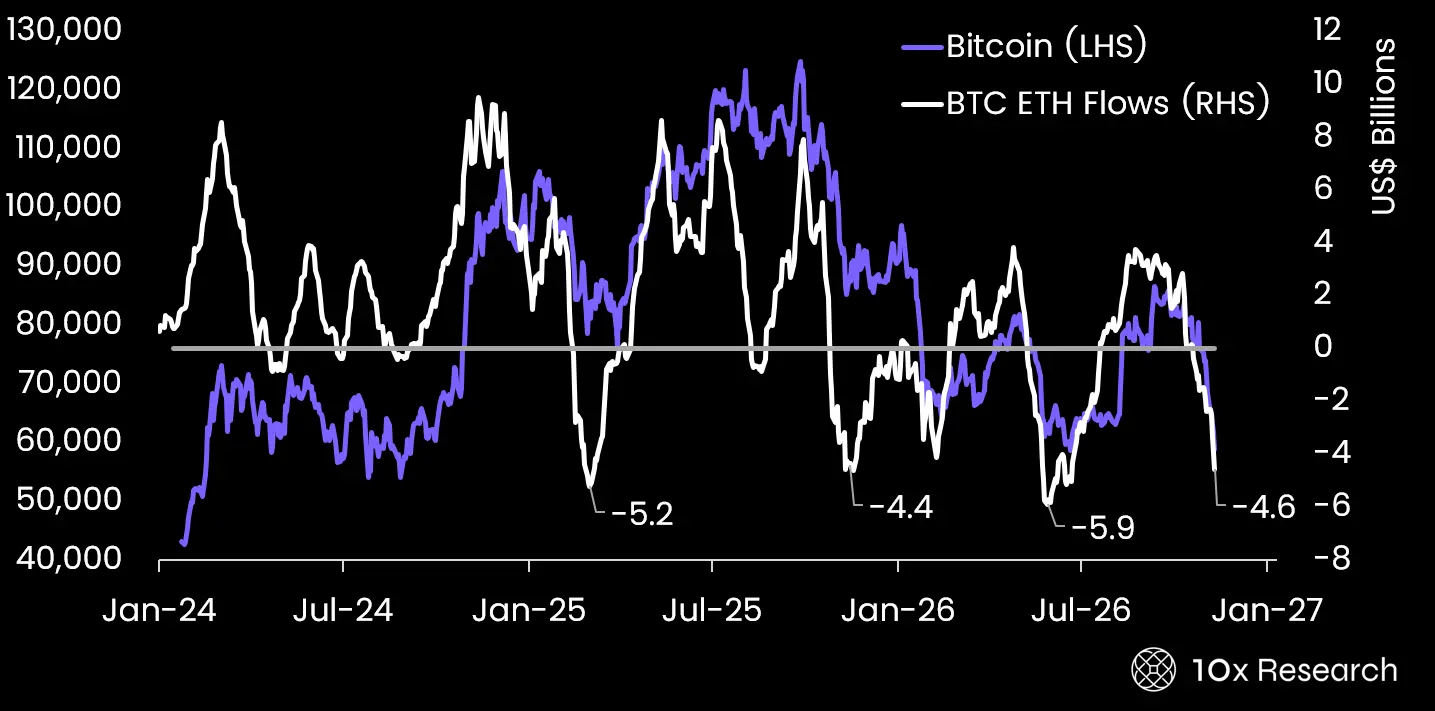
10x Research counted four episodes since early 2025 in which Bitcoin ETFs lost between $4 billion and $6 billion over a rolling 30-day period. Its latest reading was about $4.6 billion, distinct from RootData’s $5.7 billion calendar-month-to-date figure. Each of the three earlier episodes accompanied a Bitcoin decline of about $20,000, and the heaviest outflows roughly coincided with local price lows. Three observations are too few to establish that the pattern will repeat.
Year-end tax decisions add another uncertainty. During Christmas week in 2025, Bitcoin ETFs recorded about $1.1 billion in outflows over six consecutive days. For 2026, 10x Research estimated that about $14 billion in ETF positions carried unrealized losses that holders could choose to realize by December 31. That figure measures positions held at a loss, not projected withdrawals.
ETF shares are subject to US wash-sale rules, which restrict claiming a loss when the investor promptly repurchases the same or a substantially identical security. Direct Bitcoin holdings are not subject to the same restriction. Some investors selling ETF shares could therefore retain Bitcoin exposure. A January return to ETF inflows after tax-related selling was a possibility, not an observed reversal.