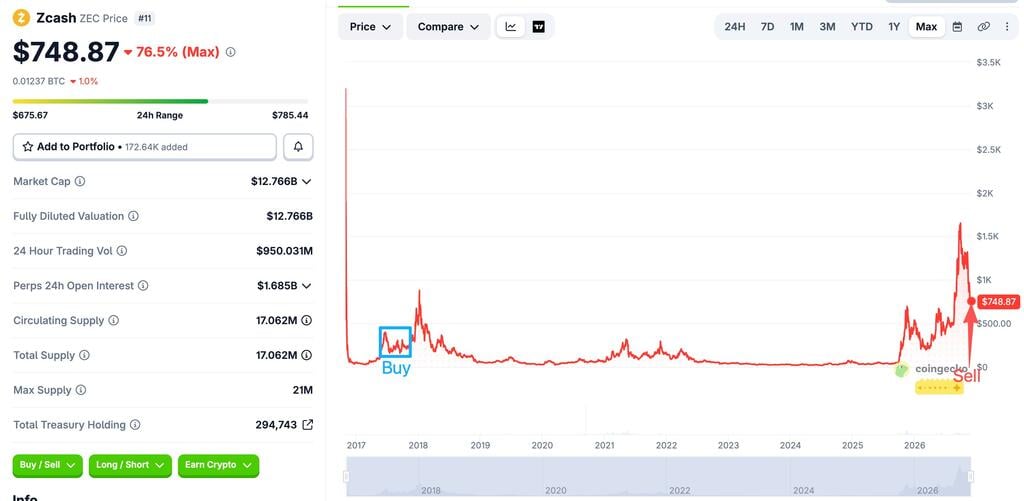
A Zcash holder moved 15,750 ZEC worth $11.39 million after nine years of inactivity, Lookonchain reported on November 26, 2026. Arkham data showed two transfers: 8,000 ZEC worth $5.73 million went to an address Arkham had not labeled. About an hour later, 7,750 ZEC worth $5.66 million went to a Kraken deposit address.
Lookonchain said the holder had bought 23,412 ZEC for $5.04 million at an average price of $215 per coin. Arkham traced the coins to withdrawals from a Zcash shielded pool nine years earlier, most in batches of 250 ZEC. Lookonchain described the holder as selling and put the total profit on the position at more than $12 million. The transfers show where the coins went, but do not establish that a sale took place or how much profit the holder realized.
Developers ask users to leave Sapling
In a separate development on November 26, Zakura, the Zcash development team led by Sean Bowe and Dev Ojha, asked users to move their ZEC out of Sapling, a pool used for private transactions. Sapling launched in October 2018 and still held about 400,000 ZEC, according to the team. Zakura did not describe a confirmed failure of Sapling’s cryptography: “Practical pairing breaks are highly speculative,” it wrote.
The request differs from the protocol change that stopped new deposits into Sprout, Zcash’s first shielded pool. According to the Electric Coin Company, that restriction took effect with the Canopy upgrade at block 1,046,400 on November 18, 2020. Zcash’s latest upgrade, NU7, activated at block 3,543,405 on November 6, 2026. According to ZIP 218, it shortened the target interval between blocks from 75 seconds to 25 seconds.
Exchange activity and the proposed Zcash ETF
Lookonchain also reported on November 26 that a different holder deposited about 47,500 ZEC, worth $35.8 million, to Binance. CoinGecko quoted ZEC at $748.87 that day after a 24-hour low of $675.67. Its market capitalization of $12.77 billion ranked it 11th among cryptocurrencies.
ZEC had traded around $927 on November 18. A day earlier, BitMEX co-founder Arthur Hayes had set a $1,800 price target without a deadline. He grouped Zcash with Ethereum, NEAR and Venice Token as his “Four Horsemen,” but described his own ZEC position as “small to medium as conviction is meh.”
Bitwise filed an S-1 registration statement on November 17 for a proposed Zcash exchange-traded fund. Under the filing, the fund would trade on the Texas Stock Exchange under the ticker ZEC and would use neither staking nor shielded transactions.