
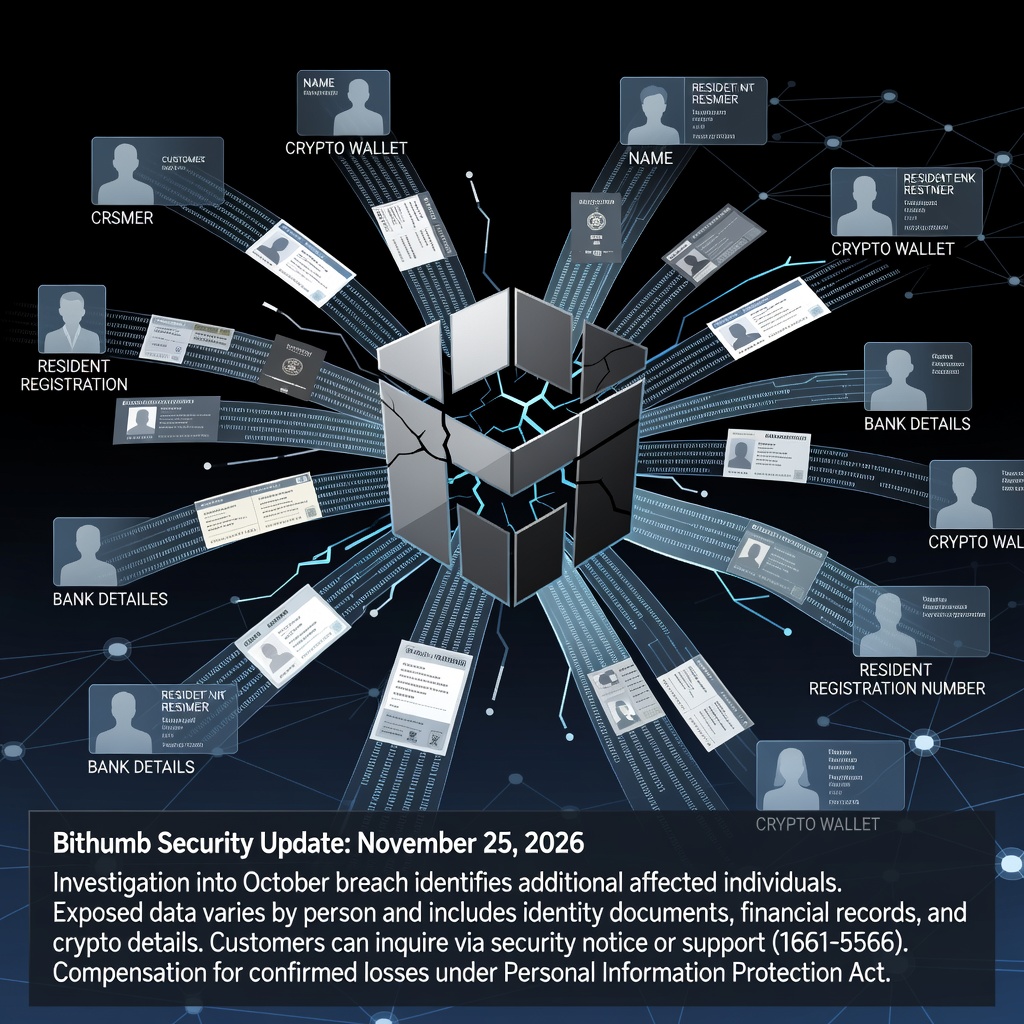
South Korean crypto exchange Bithumb said on November 25, 2026, that its investigation into an October breach had identified more people whose data was taken. The stolen records included copies of identity documents, bank account numbers, transaction histories and crypto wallet addresses. What was exposed varies by person, and Bithumb did not give a revised count of those affected.
Customers can check which of their records were exposed through the personal information inquiry service in Bithumb’s security notice or by contacting its support center. The exchange said it would also notify affected customers individually by email and text message. Those whose identity documents were exposed will receive separate guidance on replacing them and monitoring their financial accounts.
A workplace system, not the trading platform
The update concerns the same incident Bithumb disclosed on October 29. Investigators found that an unauthorized external party accessed DaouOffice, a workplace collaboration system developed by Daou Technology, between 1:49 p.m. on October 12 and 3:22 p.m. on October 27. The party took files and personal information stored in that system.
Bithumb said DaouOffice operates separately from its trading platform and the systems that hold customer asset information. Investigators found no evidence that the attacker directly accessed the exchange’s trading services or customer database.
The affected people include customers, employees of partner companies, and current and former Bithumb employees. In addition to financial and transaction records, the disclosure listed names, membership numbers, contact details, birth dates, home addresses, South Korean resident registration numbers, passport numbers and driver’s license details. Some records also contained occupations, employer names and workplace contact information.
Account protection and compensation claims
Bithumb suspended its use of DaouOffice, blocked the attacker’s IP addresses and formed an incident response team. The exchange said it had addressed the vulnerability with Daou Technology and was inspecting its publicly accessible services. It also introduced round-the-clock monitoring for unusual logins and suspicious crypto withdrawals, along with additional identity checks for certain transactions.
Bithumb warned that someone using stolen details could pose as an exchange representative to obtain credentials or persuade a customer to transfer crypto. It said it does not ask for passwords or authentication codes by phone, text or messaging app. It advised customers not to disable one-time password authentication, install unfamiliar apps or grant remote access to their devices.
Bithumb set up an assistance channel for complaints, financial and legal consultations, and compensation claims. It pledged to cover damages confirmed to have resulted from the breach, but said it would assess each claim under the applicable legal requirements before determining relief.
Bithumb’s support center is available year-round, 24 hours a day, at 1661-5566. In South Korea, customers can report privacy violations to the Korea Internet and Security Agency at 118. Those who suffer losses can seek compensation or apply for dispute mediation under the Personal Information Protection Act. The Personal Information Dispute Mediation Committee can be reached at 1833-6972.