
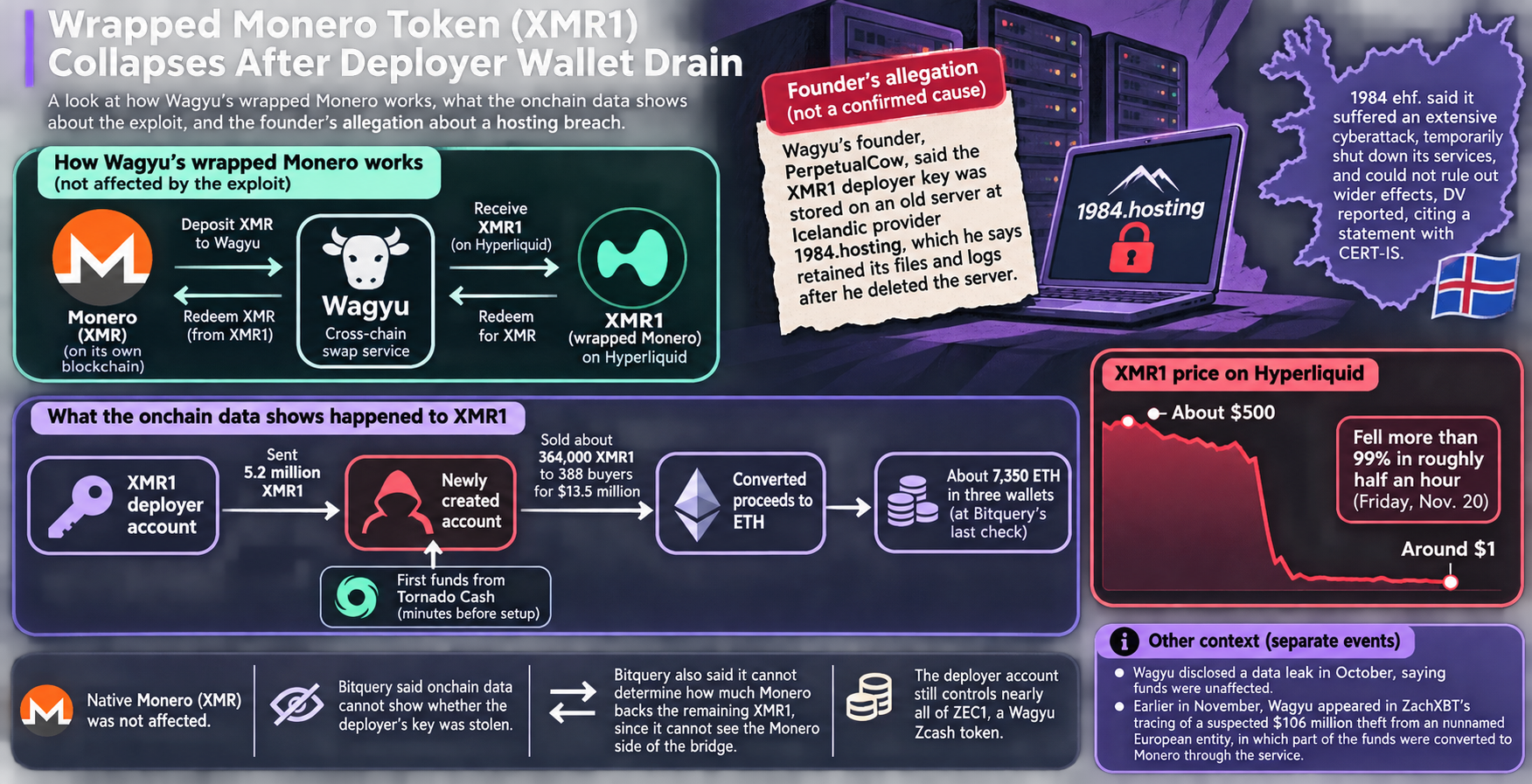
For builders running a wrapped-token service, control of the deployer wallet is a critical security boundary. In reporting published on November 21, 2026, XMR1—the token issued by cross-chain swap service Wagyu to represent Monero on Hyperliquid—had fallen more than 99% in roughly half an hour on Friday, November 20, from about $500 to around $1. Native Monero was not affected.
Wagyu lets users deposit Monero, which runs on its own blockchain and cannot trade natively on Hyperliquid, in exchange for XMR1 that they can later redeem for Monero. According to onchain data firm Bitquery, the account that deployed XMR1 sent 5.2 million tokens to a newly created account early Friday. That account sold about 364,000 XMR1 to 388 buyers for $13.5 million and converted the proceeds to ETH. At Bitquery’s last check, about 7,350 ETH sat in three wallets.
What is known about the breach
Wagyu’s pseudonymous founder, PerpetualCow, blamed a breach at Icelandic provider 1984.hosting. He said the XMR1 deployer key had been stored on an old server he had deleted, but alleged that the provider retained its files and logs. That account of how the key may have been exposed has not been established by the onchain transactions alone: Bitquery said those records cannot show whether the key was stolen. Nor can Bitquery determine how much Monero backs the remaining XMR1, because it cannot see the Monero side of the bridge.
Icelandic outlet DV reported Friday that 1984 ehf., the company behind the hosting service, had described an extensive cyberattack on its IT infrastructure in a joint statement with Iceland’s national cybersecurity incident response team, CERT-IS. The company temporarily shut down its services and said it could not rule out effects on systems beyond those already confirmed. The statement did not mention Wagyu or say whether customer data had been taken.
PerpetualCow said he would personally refund everyone who lost money and that Wagyu would relaunch, without giving a timeline. Bitquery also noted that the account receiving XMR1 had received its first funds from Tornado Cash minutes before it was set up, while the deployer account still controlled nearly all of ZEC1, a Wagyu Zcash token.
The incident followed a separate data leak Wagyu disclosed in October, when it said funds were unaffected. Earlier in November, Wagyu also appeared in ZachXBT’s tracing of a suspected $106 million theft from an unnamed European entity; part of those funds were converted to Monero through the service. Neither detail establishes a connection to the XMR1 incident.