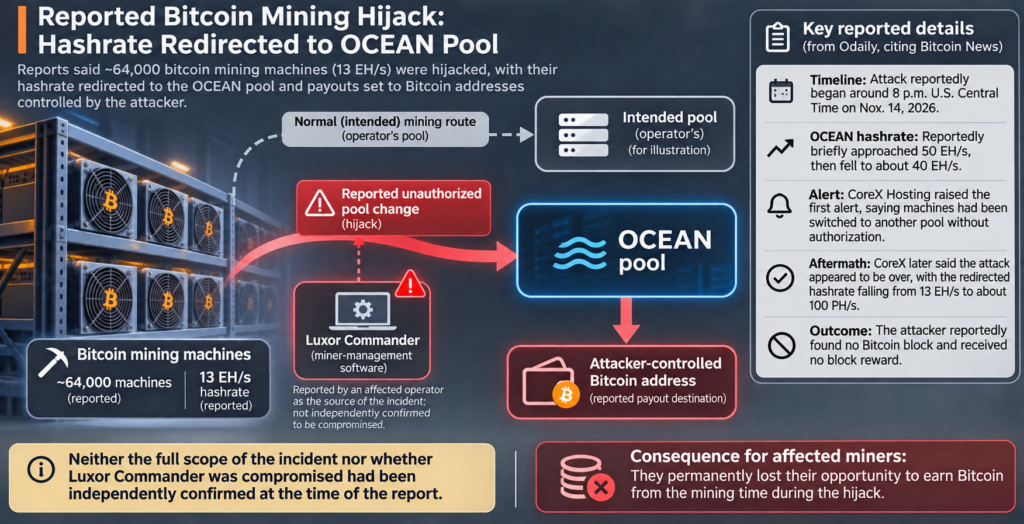
For a mining operator, an unauthorized pool change can redirect a machine’s work—and potentially its rewards. In a report published on November 15, 2026, Odaily said Bitcoin News had tracked reports that roughly 64,000 Bitcoin mining machines were hijacked. Their combined 13 EH/s of hashrate (computing power used for mining) was reportedly directed to the OCEAN pool, with payouts set to Bitcoin addresses controlled by the attacker.
The attack reportedly began around 8 p.m. U.S. Central Time on November 14. OCEAN’s dashboard showed its hashrate briefly approaching 50 EH/s before falling to about 40 EH/s. CoreX Hosting raised the first alert, saying machines had been switched to another pool without authorization. CoreX later said the attack appeared to be over and that the redirected hashrate had fallen from 13 EH/s to about 100 PH/s.
One affected operator said its entire mining site had been hijacked and identified Luxor’s Commander miner-management software as the source of the incident. Other operators reported similar unauthorized pool changes in the preceding days. Neither the full scope of the incident nor whether Luxor Commander was compromised had been independently confirmed at the time of the report.
The attacker reportedly found no Bitcoin block during the hijack and therefore received no block reward. The affected miners nevertheless permanently lost their opportunity to earn Bitcoin from that mining time.