
For builders integrating with Aave, the practical change in V3.8 is a new guard around lending-pool callbacks: it is designed to block certain reentrant calls without preventing a flash-loan callback from performing a liquidation, deposit or repayment.
As reported on November 12, 2026, the Aave DAO-approved release, developed by Aave Labs, had gone live across active Aave V3 markets on 15 chains. The rollout included Ethereum’s Core and Lido instances, as well as markets on Plasma, Avalanche, BNB Chain, Monad, Base, Arbitrum, Mantle, X Layer, Polygon, Linea, Optimism, Gnosis, MegaETH and Celo. Frozen legacy markets with limits set to zero were excluded.
Aave Labs posted the V3.8 governance-forum proposal on October 21, followed by a Snapshot vote on October 27. On-chain voting for AIP #541 began on November 9. The report describes a 22-day span from proposal to deployment.
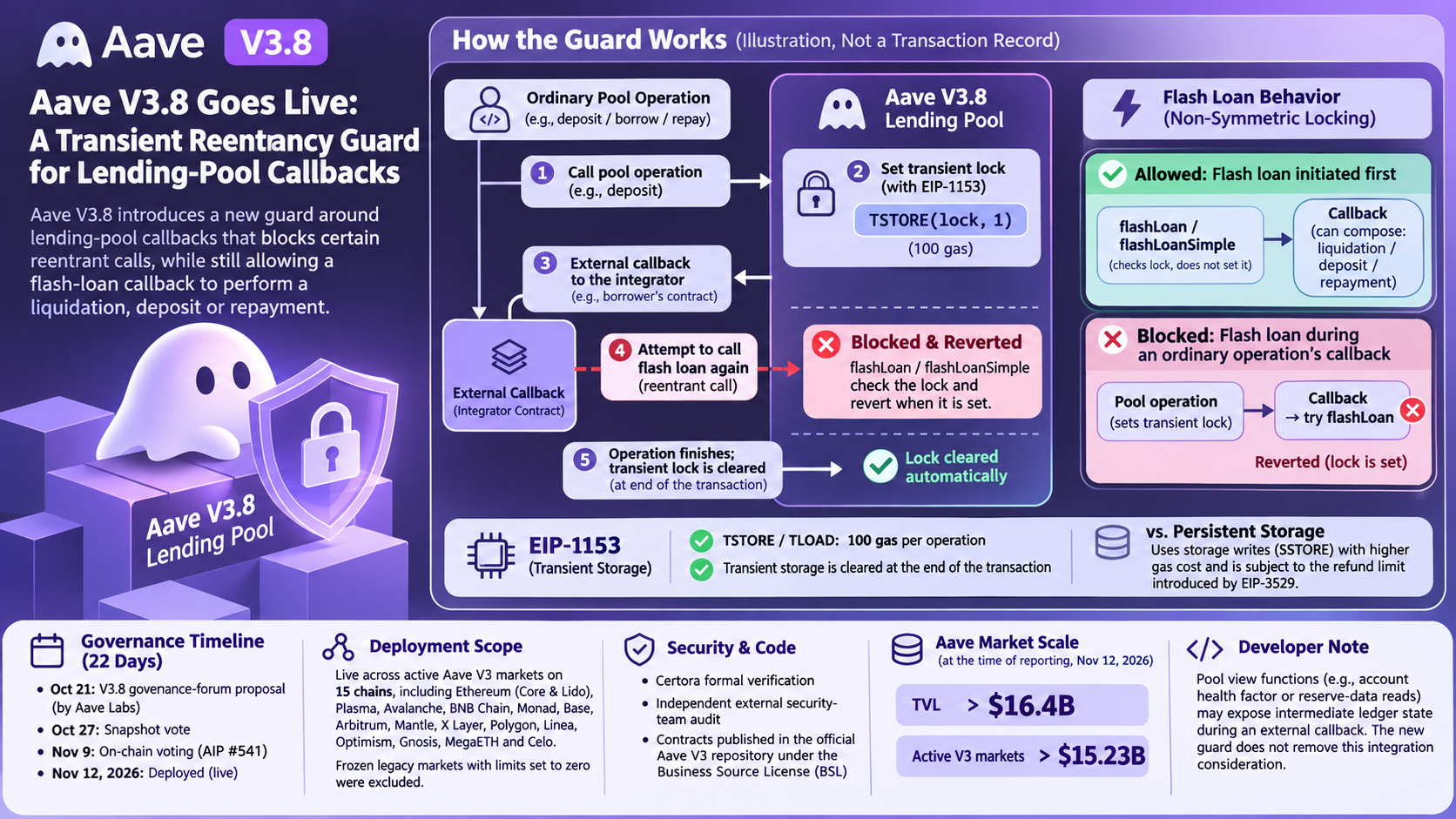
How the guard works
A reentrant call occurs when an external callback calls back into a contract before its initial operation has finished. V3.8 uses EIP-1153 transient storage for its lock: TSTORE and TLOAD cost 100 gas per operation, and transient storage is cleared at the end of the transaction. The report contrasts this with a persistent-storage lock, noting the gas cost of storage writes and the refund limit introduced by EIP-3529.
Aave Labs said the flashLoan and flashLoanSimple entry points check the lock but do not set it. That lets a flash loan initiated first compose actions such as liquidation, deposit or repayment inside its callback. By contrast, a flash-loan attempt made during the callback of an ordinary pool operation is blocked and reverted.
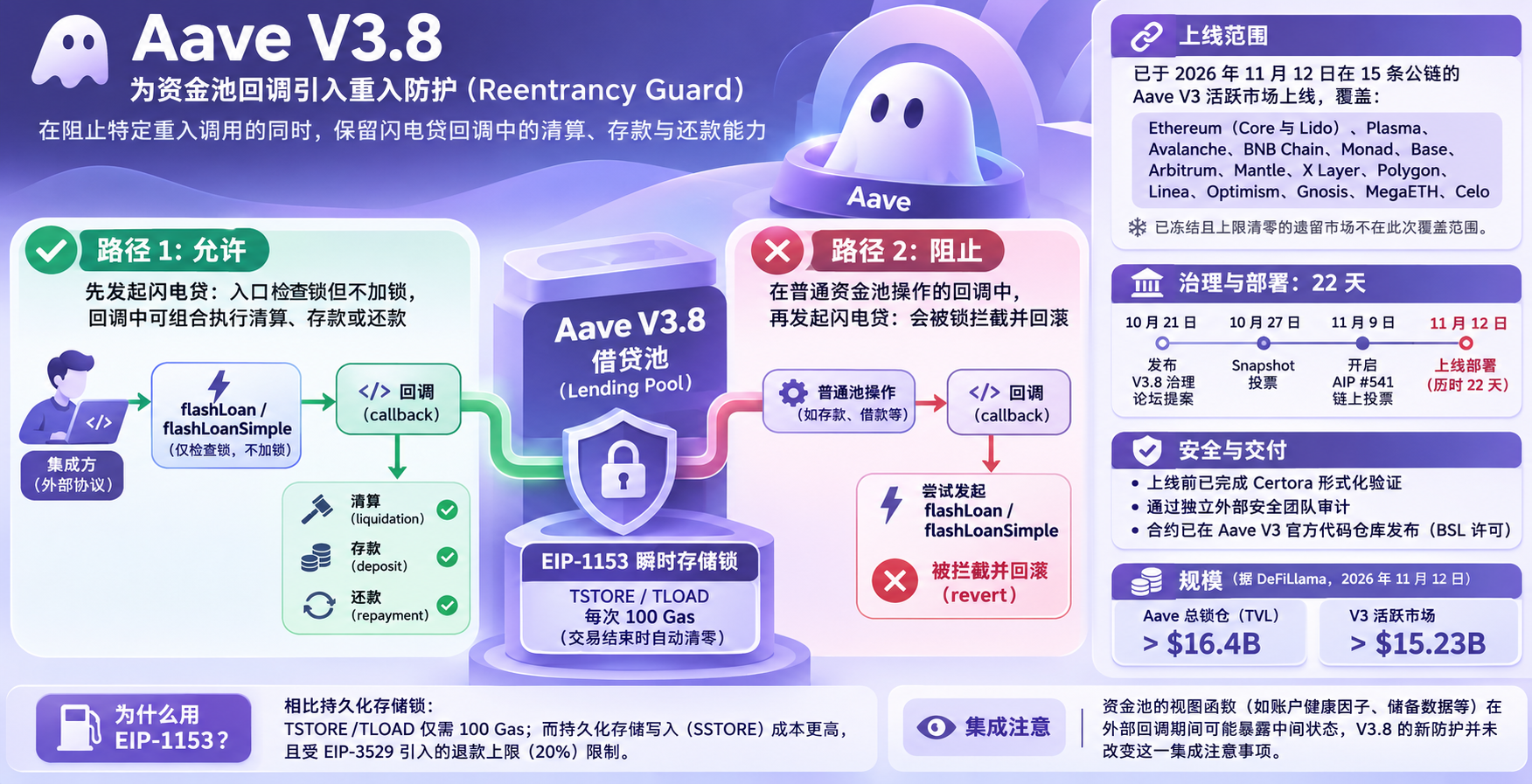
The report says V3.8 underwent Certora formal verification and an independent external security-team audit before the AIP vote. The contracts were published in the official Aave V3 repository under the Business Source License (BSL). Community developers also cautioned integrators that pool view functions—including account health-factor or reserve-data reads—may expose intermediate ledger state during an external callback. The new guard does not remove that integration consideration.
For scale, DeFiLlama figures cited in the November 12 report put Aave’s total value locked above $16.4 billion, with more than $15.23 billion in active V3 markets. Those figures describe the markets at the time of reporting, not an effect attributed to the upgrade.